

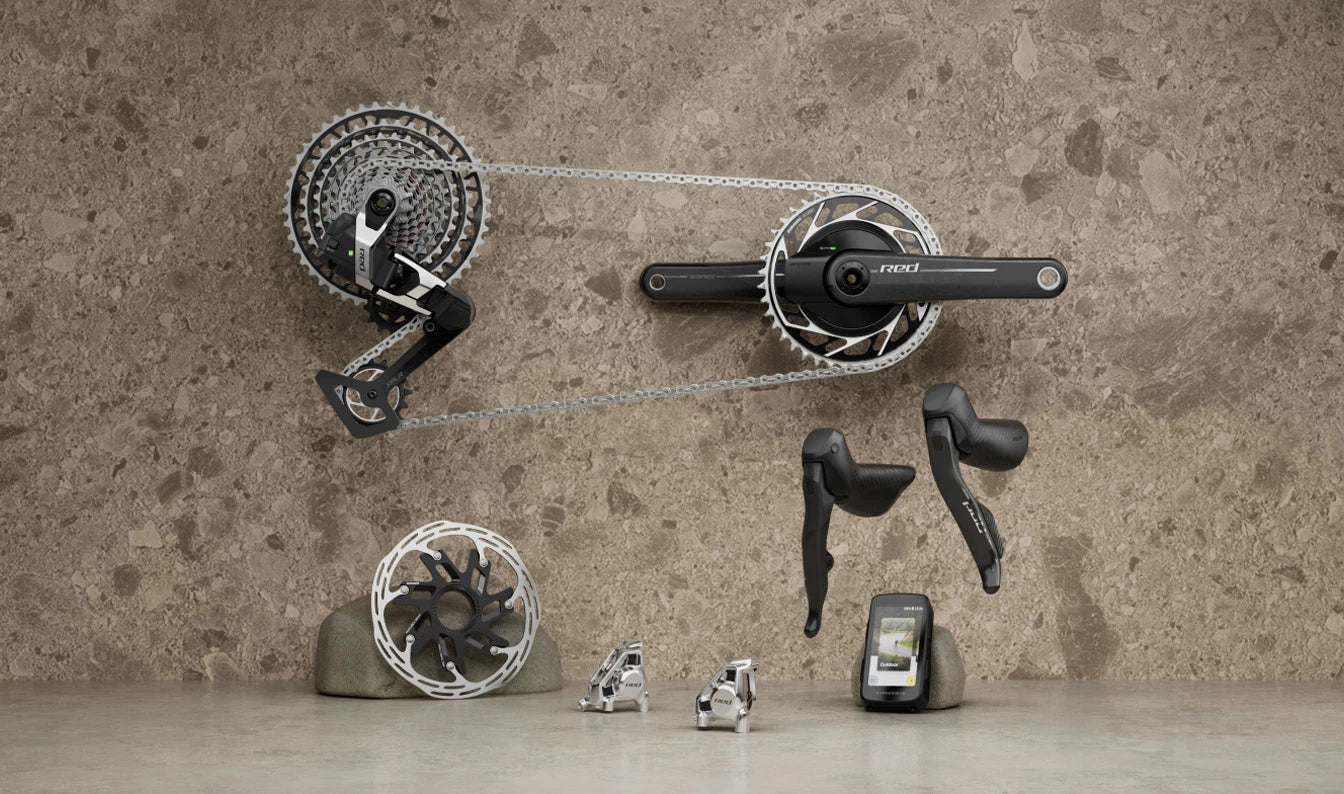
SRAM Groupset Hierarchy (2025) – From Apex to Red AXS. Which to Choose?
Today, SRAM is the brand that has introduced wireless electronics at every price point. This article shows which groupset is best for city commuting, gravel adventures, or aggressive racing—without any tech buzz.
You might be interested in: Which Shimano groupset should you choose for your bike? A review from an expert at a bike shop in Mokotów.
🔹 Apex & Apex XPLR – budget electronics, gravel light
Apex AXS is a fully wireless, 1x12 drivetrain ideal for gravel bikes and trail riders. It's smooth, easy to set up, compatible with 11-52T, and doesn't break the bank. The mechanical Apex (1x11) is an older version, but still found on more affordable off-road bikes.

🔹 Rival & Rival XPLR AXS – the perfect compromise between quality and price
Rival AXS is a 12-speed electronic system, available in 2x12 or 1x12 (XPLR) configurations, with cassettes up to 44-52T. It boasts excellent hydraulic brakes, precise shifting, and is less expensive than Force or Red. In tests, it impresses with its proximity to Red AXS quality at a lower price.

🔹 Force & Force XPLR AXS – race quality at a reasonable price
Force AXS is a higher-end model than the Rival: lighter, more ergonomic, with a carbon body and improved push-piston brakes. For gravel, there's an XPLR version with a 13-speed cassette and UDH bracket mounting. Innovation Center 2025: This groupset offers the best of Red AXS in a more accessible package.

🔹 Red AXS & Red XPLR AXS – top SRAM technology
Red AXS is our flagship 12-speed wireless groupset, lightweight and ultra-precise. Red XPLR AXS is our 1x13 gravel variant—extremely durable, ideal for bikepacking and gravel racing. It's currently the top of the line in gravel.

🧠 What are the differences between the groups?
- AXS — Every group above Apex has electronic, hydraulic disc brakes.
- XPLR - This stands for gravel version of 1× with a large range cassette and UDH compatibility.
- Rival vs Force vs Red — the difference is primarily in weight, finish, shape of the handles, availability of premium features (buttons, compatibility with blips, etc.).
📋 SRAM Groupset Comparison Chart (2025)
| Group | Running | Configuration | Application | What makes it stand out |
|---|---|---|---|---|
| Apex (Mech / AXS) | 11/12 | 1× | gravel, entry-level | electronic XPLR, a cheap option |
| Rival AXS / Rival XPLR | 12 / 12 | 1× / 2× | gravel, road, solid mid-tier | quiet operation, reliability |
| Force AXS / Force XPLR | 12/13 | 1× / 2× | gravel, road racing | lightness, braking power, ergonomics |
| Red AXS / Red XPLR AXS | 12/13 | 1× / 2× | gravel, high-end road | top technology, low weight |
Check it out now - Campagnolo Ekar GT: Affordable gravel groupset
💡 Which group should I choose?
- Want a cheap, modern gravel bike? → Apex XPLR AXS
- Looking for Red quality, but cheaper? → Rival AXS
- Lowest deceleration, highest braking level, lightness? → Force AXS
- Want only the best? → Red AXS or Red XPLR AXS

🚲 What's next?
SRAM AXS ushers in a wireless revolution—each level adds drop-bar electronics, hydraulic brakes, and full integration. The system is compatible—if you need an upgrade, you can swap levers or derailleurs without changing your entire setup.
🛠️ Don't feel like doing the installation? Come see us!
If this topic seems too technical for you, or you simply want to experience the difference between Apex, Rival, Force, and Red clickers, stop by our bike shop in Mokotów or our showroom in Wrocław. We have bikes equipped with all these groupsets and are happy to advise.

✅ Summary
SRAM offers a range of options today, but their value increases the higher you go in the hierarchy:
Apex → Rival → Force → Red
Each of these groups can be a good choice – it depends on how much you drive, what driving mode you prefer and what you expect from the drivetrain.


Leave a comment