

Which hydraulic brakes are best for a bicycle?
Hydraulics have transformed cycling, especially mountain biking. They enabled reliable braking in all weather conditions, even on very long descents. Furthermore, they allowed for the wider introduction of carbon rims. It's no surprise, then, that hydraulic brakes are on my list of the 10 most important cycling innovations . Although they provide safety, reliability, and excellent braking modulation, I'm not a proponent of pushing them onto every bike. Good V-brakes are perfectly adequate for city or touring bikes, and they're cheaper and easier to service . Nevertheless, mountain bikes are now available exclusively with disc brakes (which is a good thing!), and increasingly, this also applies to road bikes (a topic for a separate discussion). Fortunately, rim hydraulic brakes are practically extinct (that wasn't a good idea). In this article, I'll try to outline my experiences with the most popular brands and answer the question of which ones are the best choice. This article is written from a mechanic's perspective, based on experience in servicing, amateur use, and the opinions of regular customers and riders. This also answers the question of why we install Shimano hydraulic brakes on our bikes . If you disagree, that's great – leave a comment and let's talk about our passion!
Avid/Sram, or it's getting better
Let's be honest, Avid brakes were terrible. They weren't cheap and didn't stop well, especially the lower-end models. They had poor modulation, though strong stopping power, which earned them a few fans. However, the biggest problem was (and is) bleeding. Using synthetic DOT 5.1 fluid is never pleasant (it damages leather, plastics, and paint), and Avids require a complicated procedure involving creating a vacuum using two syringes. To make matters worse, DOT likes to eat up the seals. As a result, bleeding a few-year-old model can become a frustrating nightmare—many repair shops charge double for the job. And bleeding often requires frequent cleaning because after replacing worn pads, the pistons often refuse to return to their original position, making adjustment impossible or very difficult. Therefore, replacing them with the cheapest Shimano hydraulic brakes is often suggested—a faster, cheaper, and more effective solution.
 Three times no! Photo by: nooxnet
But you can
Yes, this mechanics' nightmare has been given a new lease on life. SRAM has finally recognized that their brakes are having some issues. For several years now, the cursed Avid name has disappeared, replaced by the unfortunate (in Poland) name of the American giant. While irritating bleeding remains, seal issues have disappeared, and modulation has improved significantly. This is important because, in the case of road and gravel groupsets, we're stuck with a single manufacturer for brakes and drivetrains. And it must be admitted that SRAM groups are hard to resist.
 Absolutely! Author: Glory Cycles
You may be interested in - How to replace a bicycle brake cable?
Shimano - the most popular hydraulic brakes on a bicycle
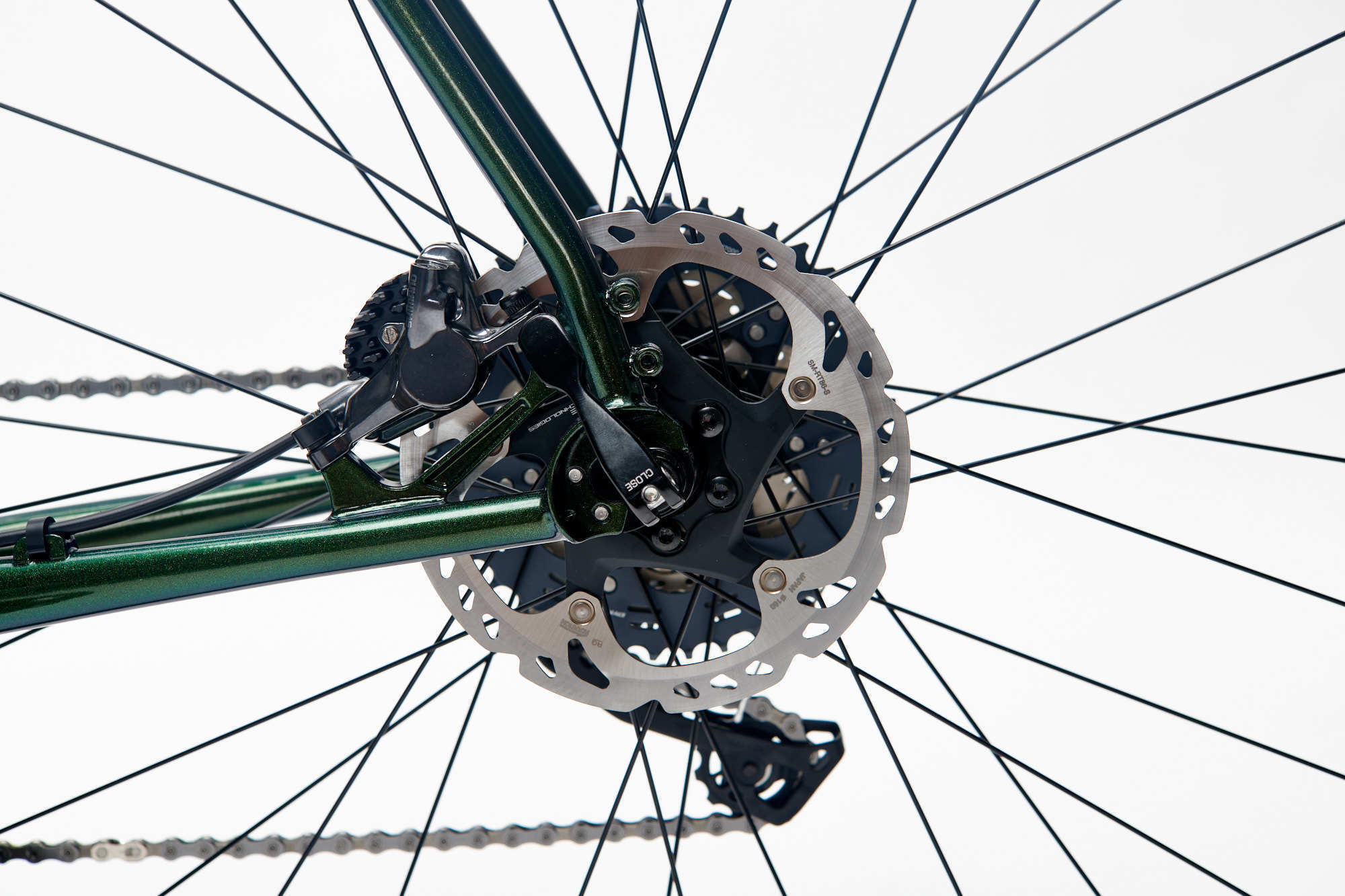
I'll be honest – I love Shimano brakes. Why? Because even their cheapest model (under 200 PLN for a set), the MT-200, works great, especially if you invest in better rotors. This means installing them is often comparable to rebuilding an old Avid, and the results are much better. For racing, however, it's worth paying a little extra and at least getting Deore or SLX brakes. The latter already have full-fledged single-finger levers and, in my opinion, represent the best value for money on the market. The same applies to the rest of Shimano's entire hydraulic brake line, perhaps excluding the cheapest RT-26 rotors (they're crooked from new) and the, in my opinion, seriously flawed idea of cheap hydraulic levers for flat handlebars.  What else sets them apart? High reliability and incredibly easy maintenance. Excellent modulation and brake feel, high efficiency, and reliability. They run on mineral oil, which isn't as harmful to the environment, bikes, or mechanics as DOT. Furthermore, parts are easy to obtain. But here's the downside. The manufacturer doesn't offer many of these parts. A broken lever? The entire lever needs replacing. However, considering the price, I can forgive them for that.
Magura, i.e. German quality
A specialty of our neighbors across the western border. Magura brakes are most often found in German bikes, although they're also often found in top-of-the-line Specialized models. They stand out for their excellent quality and distinctive design. Like Shimano (and most of this list, except for Avid/Sram and Hope), they use mineral oil. They operate very similarly to their Japanese competitors, though they have a distinctly different lever shape. I definitely don't like it, but there are those who won't accept anything different. A major advantage is the comprehensive range of spare parts. Unfortunately, Magura brakes are more expensive than comparable Shimano models. This also applies to servicing, which requires a special fluid called Royal Blood. It's also worth remembering that not every (read: most) workshop is equipped with it, which can impact the wait time and cost.
 Their elegance and quality are undeniable, though there are also more flashy models. Author: Richard Masoner / Cyclelicious
Check now - Hydraulic bicycle brakes - which are the best?
TRP - hydraulic brakes on a bike... without hydraulics?
Most models from this Italian manufacturer are unremarkable – just average, uncommon. However, the Macaronianiacs came up with a very clever idea: they created a hydraulic caliper that operates connected to a standard road bike shifter cable. This immediately caught the attention of anyone looking for an affordable gravel bike without having to spend almost their entire budget on a hydraulic gravel or road groupset . At first, I scoffed at the idea, only to swallow my pride after testing it out. The clever TRP HY/RD brakes work great, with modulation and feel only slightly inferior to full-fledged hydraulics. Cheers !
 Defying the stereotype of Italian technology. Photo from the manufacturer's website.
Hope - for CNC enthusiasts
Highly regarded in the world of downhill and enduro, Hope brakes are hard to confuse. Their distinctive machined shapes and multi-colored anodes stand out from afar and allow for the construction of a unique bike (though they look rather gaudy to me). There's no denying their durability and immense power. They use synthetic oil, but their servicing isn't as horrendous as SRAM's. Unfortunately, the manufacturing method makes them quite expensive. A major advantage of their construction is their full serviceability, making Hope brakes a long-lasting purchase. Furthermore, when combined with other brand parts, they can create a very cohesive design. It's also worth noting that the brand offers two models designed for those who can only control the brakes with one hand. Available are versions with a single lever for both brakes, and a double lever. Respect! The former will also work well on all types of tricycles.
 Classy! Photo from the manufacturer's website.
Tektro, Hayes, and Other Hydraulic Brakes You Don't Want on Your Bike
Of course, there are still plenty of well-known and lesser-known brands on the market. Most of them are difficult to recommend, however, either due to poor quality workmanship or problems with service or parts. The most popular are probably Tektro. They perform noticeably worse than the cheapest Shimano (while costing more) – rather dull and rubbery, but still quite effective. They do tend to squeak and make noise. I once had Tektro hydraulic brakes on my bike – they worked well, but the noise every time I stopped was incredibly irritating. Hayes and Formula are also worth mentioning. While their more expensive models are more common in the West (and even have loyal fans), in Poland, you'll most often find their basic, often dated offerings. And these, to put it mildly, don't perform very well. If you've used higher-end models from these brands, please share your experiences; I'm very curious.
There can only be one winner
So what are the best hydraulic brakes on a bike? For me, the Japanese giant almost always wins. Shimano brakes are simple, incredibly effective, and yet affordable (okay, XTRs aren't exactly cheap, but they're still significantly cheaper than the competition at this level). Furthermore, their refinement and ergonomics are unmatched, though that's obviously a very subjective matter. That's why we put them on our gravel bikes . I'd rank the latest SRAM products next, mainly because they're paired with phenomenal components in road groupsets. In MTB, where you're not so tied down, I choose the American drivetrain and Japanese brakes . Magura and Hope are tied for second place, and TRP gets a badge of approval for creativity. I suggest burning the rest, with Avid brakes at the top.



Dziękujemy za pozostawienie komentarza :)
Zgadzam się, taki hamulec potrafił lepiej hamować od droższych i rankingowo lepszych modeli. Pozdrawiam!
Przejeździłam parę lat z avidem juicy 7 – kupione w okolicach 2006 roku … to był super hamulec.
Leave a comment