

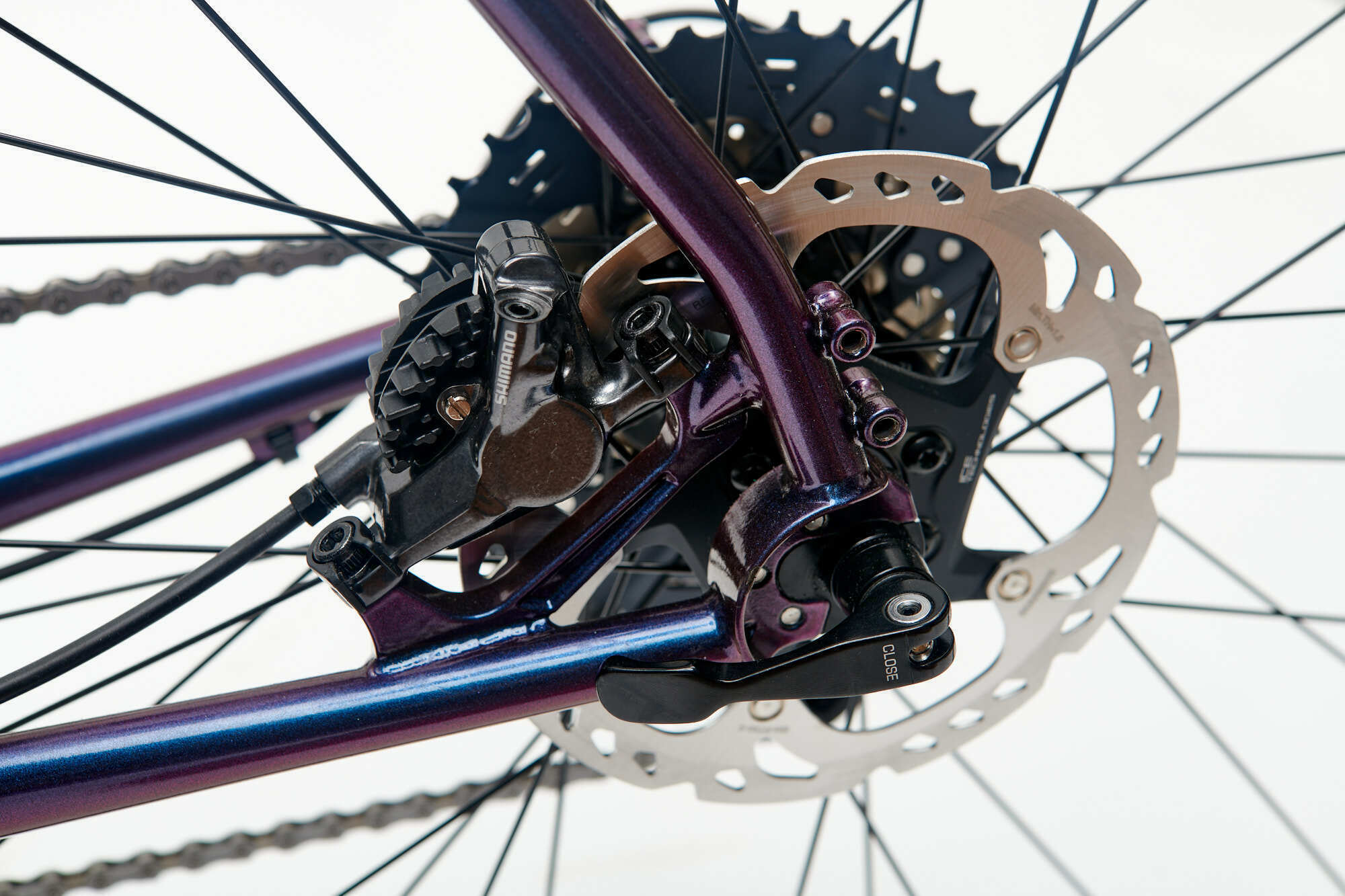
How do you attach a wheel to a bicycle? It would seem trivial. Just screw it on. But it turns out that's not enough. A century ago, Mr. Tullio Campagnolo recognized this and created the first bicycle quick-release to simplify wheel shifting with a flip-flop hub. It was good, so good that it became the standard wheel mounting system for most bicycles for most of their history. But then came mountain bikes (and especially downhill bikes), disc brakes, larger wheels, and riders' demands increased. Thus, a need arose for a new solution, and the answer is the thru-axle. What's the deal?
Real advantages
In the standard solution, the wheel is mounted from below, so you have to press the bike against the ground before tightening the quick release to ensure the wheel is perfectly seated. The problem is that this solution is not very precise, at least for disc brakes and when you're in a hurry. The rigid axle is mounted in a closed, circular hole, so the wheel always sits exactly the same and the chance of it falling out is significantly reduced. This also allows for better load distribution, allowing for lighter frames. The axle itself has a larger diameter, which, combined with the stiffer connection, translates into improved bike handling in corners.
The only drawback is the longer wheel replacement time (you have to unscrew it completely and remove it on one side), although several companies have developed special solutions for the impatient. What can be confusing is the sheer number of standards. Let's clarify the situation.
Rigid axle in MTB
It first appeared in downhill forks. These were massive tubes measuring 112 x 20 mm. A 150 x 12 mm tube was used in the rear. However, when the market began to mature and the already proven solution was used in XC and other less extreme disciplines, they decided on a 100 x 12 mm setup up front and 135 x 12 mm, only to quickly upgrade the latter to 142 x 12 mm. And things only got worse, as the thru-axle system fell into the typical industry whirlwind of introducing new standards . Boost emerged – a wider standard that allows for increased wheel stiffness and a more decoupled drivetrain. Boost axles are available in 110 x 15 mm and 148 x 12 mm. This is currently the most popular standard in new mountain bikes. Think that's the end? No! Then there's the Super-Boost, used primarily on e-bikes, which has a whopping 157 mm in the rear. Interestingly, this is also the width used today in downhill, but the difference is the distance between the chainring and the chainring. It can't be too straight.

Rigid axle on the road - standards
A thru-axle on a road bike was as challenging to implement as disc brakes. The two were inherently related, and today it's no longer surprising. So far, it hasn't branched out much. Initially, the 100 x 15 mm and 135 x 12 mm standards were used, but bikes with this solution are very few. Most road bikes currently in production have a 100 x 12 mm front axle and a 142 x 12 mm rear axle. We use this setup on our gravel bike . Some are also hesitantly introducing the road Boost—110 x 12 mm plus 148 x 12 mm. It can be found on some higher-end gravel bikes.
Lack of standardization
There's a slight problem. The specified lengths refer to the distance between the frame or fork stays. This means that choosing a hub for a thru-axle won't be a problem. All you need to do is know the standard or measure the axle diameter and the amount of space for the hub. The thru-axle itself, however, is a different matter. They can differ in thread length, pitch, end type (flat or tapered), and overall length, which depends on the thickness of the dropouts. Needless to say, different manufacturers offer completely different values? So, if necessary, it's easiest to buy the part directly from them. Fortunately, they're almost always included with the frame or fork. If you're looking for a replacement, you might be in for a tough road, although there's some consolation in knowing that many axles have all this information printed on the body.
Despite the confusion, I believe that the thru-axle in bicycles is a phenomenal invention that should have become standard long ago. It increases the stiffness of the wheels and the entire bike, and it's an idiot-proof technology that simplifies life. And that's appreciated.



Leave a comment