

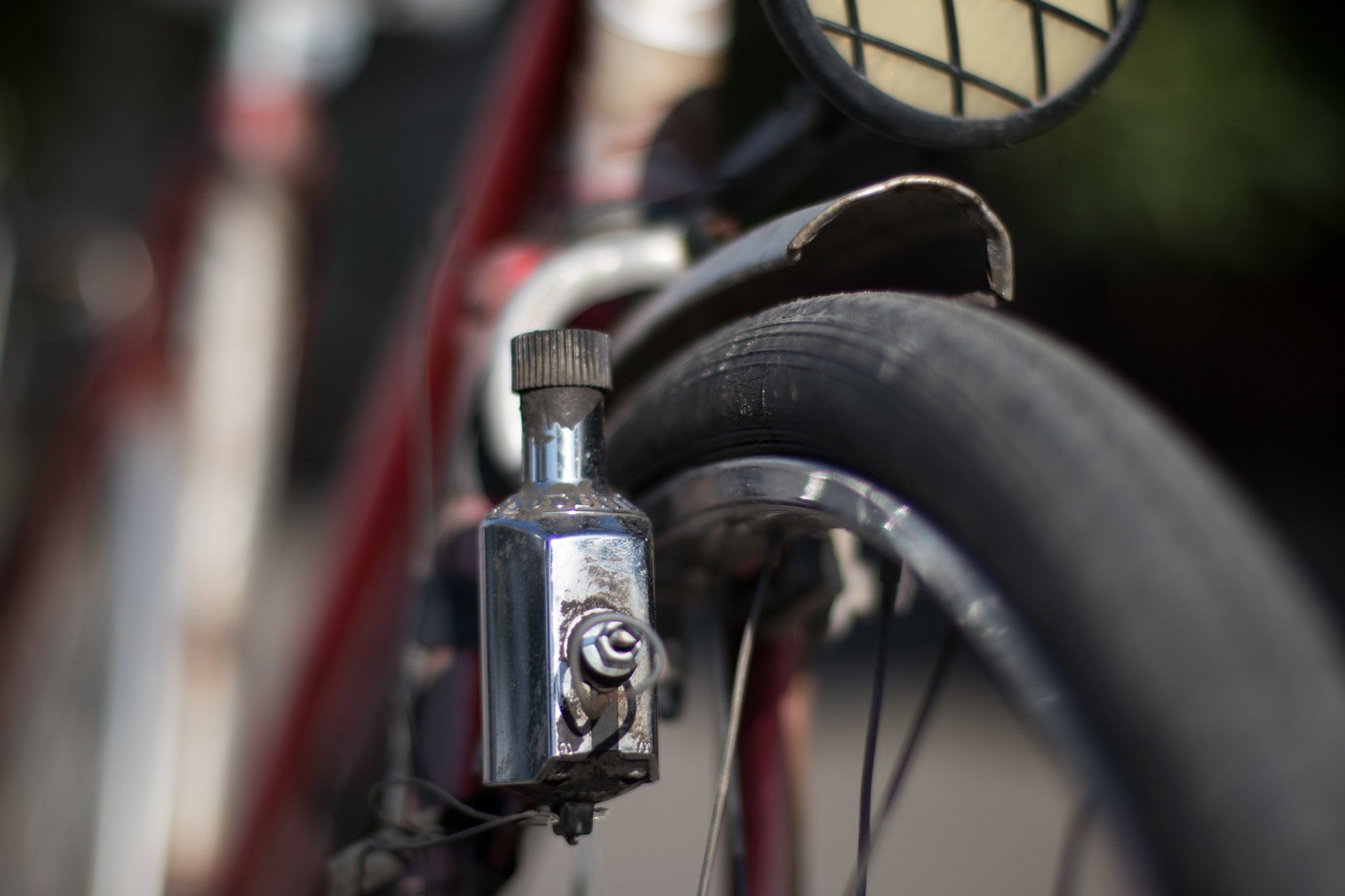
Everyone knows what a dynamo is. Well, not entirely. How many of you have ever taken one apart and examined the inside? And although it's not a complicated mechanism, it's worth taking a closer look at. It's simply fascinating. Especially since we can also take a look at the changing trends in bicycle lighting and dispel a few myths. I'll also explain why the dynamo itself, which seemed to have faded into history, has triumphantly returned in a completely new (or is it?) form.
The bicycle dynamo is an old and effective way of lighting
Used for over a hundred years (introduced to wide distribution by Bosch in 1923), it enabled effective road lighting and increased cyclist safety. Considering that previously various types of carbide lamps, candles (!), and huge, inefficient batteries were used for electric lamps, it was a true revolution. Best of all, the design remained virtually unchanged throughout all this time.

The dynamo is a very simple mechanism
A bottle bicycle dynamo consists of a stationary magnet connected to a housing and mounted on a winding rotor. The latter is rotated by a circular friction element protruding from the housing, somewhat resembling a bottle cap. The bicycle dynamo is mounted on the fork or rear stays. Simply resting it against the side of the tire activates the system and begins producing alternating current (AC) at approximately 2-3 watts and 6 volts. The biggest advantage of this device is that it generates no resistance when not in use. With proper setup, it won't cause any significant problems during operation. Furthermore, it's radically low cost and independent of batteries and chargers. A bicycle dynamo generates AC, although most modern systems have a rectifier (usually located in the front light). This allows for the use of LED lighting and the charging of various devices.
There is no shortage of flaws
Dynamos' poor reputation stems largely from improper installation, the low quality of many components, and sloppy use. Improper adjustments contribute to excessive resistance and tire wear. Problems with electrical systems typically result from loose or frayed cables. A properly installed bicycle dynamo, along with appropriate lighting, is a simple and reliable system.

It's worth noting, however, that a bicycle dynamo isn't a powerful system. Its efficiency is typically around 70%, which, combined with the low voltage and power, provides only moderate light output, especially compared to cars and modern streetlights. Furthermore, most of them lack backup systems, so the lights go out when stopped. This can be dangerous. Furthermore, driving too fast can burn out the bulbs.
Bicycle generator, or hub dynamo
These shortcomings were quickly recognized, and the first attempts to incorporate a hub dynamo were made as early as the 1930s. This design is the opposite of the bottle-type bicycle dynamo. The dynamo's operation relies on a stationary coil attached to the wheel axle, which generates current induced by magnets attached around the circumference of the hub housing. For many years, Sturmey-Archer led the way, but these hub dynamos had significant limitations, primarily due to their heavy weight and problems with power regulation, which often burned out the bulbs. This changed with the introduction of lightweight aluminum hubs instead of steel, the introduction of electronics, and the widespread adoption of efficient LEDs. Meanwhile, attempts were also made to incorporate bicycle dynamos into the bottom bracket, but as you can easily imagine, this proved problematic.

A hub dynamo is an efficient and reliable system resistant to weather conditions. Modern systems maintain power even when stopped, charge smartphones, and provide more than adequate lighting visible from a distance. Their drawbacks remain their considerable weight and greater resistance than traditional hubs, which is why they are not used for sports. However, they are excellent for touring and city riding. In such cases, a bicycle dynamo is definitely a recommended choice and often finds its way onto our belt-driven bikes . Significant progress has also been made in protecting all electrical systems, plugs, and lamps. A bicycle dynamo is great if you value reliability and independence from the electrical grid.
Main photo by: Ivan Radic



Leave a comment