

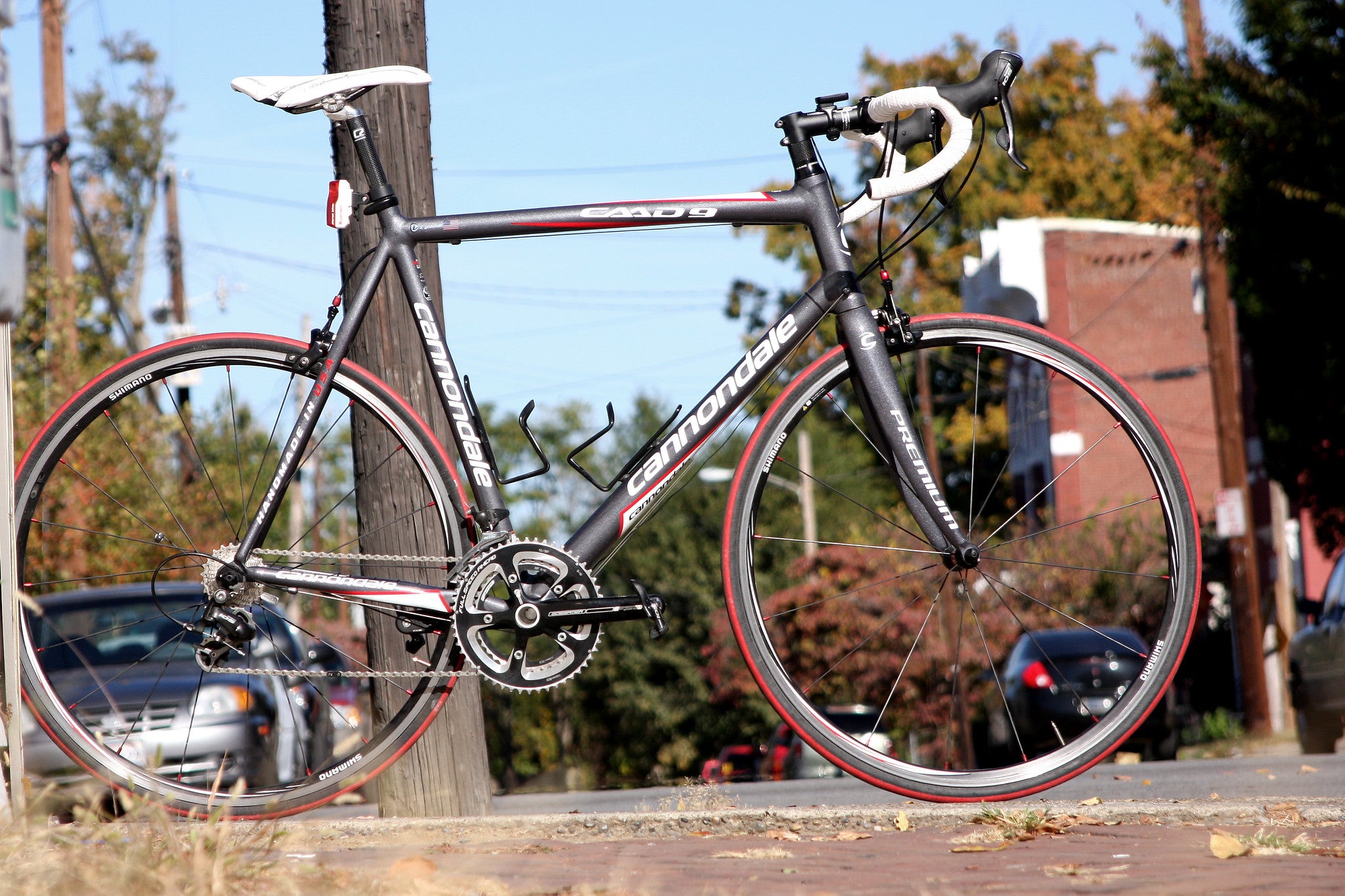
If there's one major brand whose bikes radically differentiate themselves from the competition, it's Cannondale. American bikes are not only technologically advanced, often treading a completely different path than the rest (like the aluminum CAAD series), but they're also often striking in their appearance. If you see a shock or a single-leg fork, you have no doubt who's behind it. When I first saw the silver-and-green CAAD brought in for service, I couldn't tear myself away from it. It was sleek and elegant, completely different from the knobby carbon road bikes I was used to at the time.
The constant pursuit of innovation and avant-garde design reminds me of my favorite automotive brand – Citroën. And like the French, Cannondale has a track record of pioneering concepts that have been adopted by the rest of the market, as well as spectacular failures. Similarly, it has as many supporters as detractors. It must be admitted, however, that it consistently follows its own path (today's Citroën is a bore). Although it's a completely different story than our bikes , I respect this brand like few others.
A Brief History of the Cannondale Brand
The company was founded in 1971 to... produce precast concrete products. The name comes from Cannondale Metro North, the nearby Wilton train station where the company was headquartered. The first few years were completely unfocused on bicycles. The company's next major project was an ammonia-powered engine. Such high hopes were pinned on it that they decided to finance it with other products. The first of these was an air conditioner without moving parts. Everything changed when Joe Montgomery, the company's founder, went on a bicycle trip with his son. Cannondale then created the Bugger trailer with a lexan spring, as well as lightweight bicycle bags and panniers. Within months, these products took the American market by storm, and production capacity was redirected towards bicycle touring accessories.

In 1983, another twist occurred. The brand produced its first bicycle – the ST-500 touring model – and immediately hit the big time. Literally. It was based on a thick-tube aluminum frame – much lighter and stiffer than anything available on the market at the time (steel was the norm for top-of-the-line road bikes). So, a move towards sport was natural. Aluminum frames with hand-polished welds became the brand's hallmark for many years, with bikes used to win more than a dozen world championship titles (primarily MTB) and dozens of Grand Tour stages.
In the late 1990s, the company's ambition to enter a new market—this time, it targeted motorcycles and ATVs. A delayed and ineffective reduction of production costs led to bankruptcy in 2003. The company was auctioned off—acquired by Pegasus Capital Advisors, which quickly divested itself of the motorcycle and ATV business, and in 2008, sold the rest to Dorel Industries—owner of GT, Schwinn, and Mongoose, among others—for $200,000. A year later, all production was moved to Taiwan. Gone were the hand-polished welds and the iconic "handmade in USA" inscription. The lineup was expanded to include shoddy children's bikes, but otherwise, Cannondale continues to produce beautiful and innovative bikes. Things could have been worse. Now let's focus on the essentials.
Cannondale CAAD
Oversized aluminum tubes were a market first, but the Americans went a step further. In 1992, they created the first computer-designed frame, and as if that weren't enough, they added an aluminum fork. The acronym CAAD stands for Cannondale Advanced Aluminum Design and is used to denote both the frame design technology and the model line. The bicycle industry loves all sorts of "clever" acronyms, and figuring out the meaning of random letters on a frame is a common pastime on websites. This one, however, deserves recognition.

Beyond the corporate buzzwords, CAAD is all about precisely crafted tubes with smoothly changing shapes, eliminating typical bends and double welds that solidly connect the entire unit. Add to this the best alloys and perfectly machined tubes, and you get aluminum frames that are lighter than many carbon frames. No other manufacturer creates aluminum frames at this level. Anyone who has ridden a CAAD-branded bike knows how direct the experience is – the bike responds firmly, and the power transmission and cornering are first-rate. However, nothing comes for free – increased stiffness means reduced comfort. Not everyone likes this.
Cannondale also offers top-notch carbon frames
They were also pioneers in this area and still have much to say. It's especially worth noting their SAVE microsuspension technology. This flattens the tubes so they flex in a single plane, absorbing bumps without compromising power or handling. It sounds complicated, and it is, but it works.
Headshok and Lefty
The most obvious extravagance. While you can (and there's nothing new about it) buy a bike with a traditional suspension fork from an outside manufacturer, models equipped with innovative innovations are the company's specialty. Introduced in the mid-1990s, the Headshok suspension fork, also known as the Fatty, was significantly stiffer and lighter than traditional designs by relocating the oil damper and air spring to a single unit above the rigid fork. Combined with the distinctive Super V series frames, we had incredibly... hmm... futuristic bikes. Okay, they were ugly as hell, and on top of that, this frame design was copied by market bike manufacturers at the turn of the century, so it has terrible connotations. As a kid, I had one made of steel and couldn't lift it. Still, it was in a league of its own, and V-bike riders had a significant advantage back then. And I'd gladly hug a "nice" one on Spinergy wheels just to admire its ugliness. This is an interesting classic, not another Cinelli.

Lefty shock absorber
The successor to the Headshok looks much better and performs superbly. It looks like it's about to break, but it doesn't. Shockingly, it's stiffer than its traditional competitors. This is thanks to its internal construction, based on a square profile running on needle bearings. Furthermore, this design performs equally well regardless of load. It's also remarkably light, especially since the two-crown design was abandoned. An additional advantage is that it can be mounted to any frame with a tapered headtube, regardless of its height. The Lefty, of course, also has its drawbacks. Besides the price, the biggest drawbacks are the limited hub selection and the complicated servicing – few shops offer it, and you have to be aware that it won't be cheap.

By the way, you can change the tire without removing the wheel. It seems like a small thing, but it makes a difference during a race. There's also a 30mm-travel version designed for Lefty Olivier gravel bikes.
Cannondale HollowGram and other technologies
Today, it's primarily a sub-brand of Cannondale, producing parts like stems, cranks, wheels, and handlebars. The name, however, refers to a two-piece, hollow crank technology similar to Shimano's HollowTech. When the first generation was introduced in 2001, it was 80 grams lighter than the then-current Dura Ace while offering greater stiffness. Cannondale was the first to introduce external bottom bracket bearings and increase the head tube diameter. It's also responsible for the open BB30 press-fit bottom bracket standard . The list of innovations is impressive.

Originality at all costs?
Sometimes, I guess. However, I still consider it respectable to maintain such a strong market position with such an unorthodox approach. Admittedly, I fear that the corporate structure will only keep Cannondale as "weird" as it is and cease to surprise us. It's been known for a long time that what's interesting and progressive isn't always profitable. And a great brand's job isn't to delight people, most of whom won't buy their products anyway, but to make money. Despite all this, these are beautiful bikes that appeal to my aesthetic sense more than Italian and French brands.

Main photo by Dale Goodwin



Leave a comment