


We're launching our series ("Cycling Around the City"), in which we'll share our experiences from trips to various places in Europe. This article, as the title suggests, will be dedicated to the capital of Austria. By the spring season, we also plan to tackle Copenhagen, Berlin, and Budapest. We're also planning a similar series in the future, describing our experiences and recommendations for exploring Polish cities by bike (planned for Wrocław, Gdańsk, Kraków, and Poznań).

 There's no point in dwelling on the monuments and attractions of all kinds, as Vienna encompasses not only the relatively recent history of the Imperial-Royal Empire but, above all, the centuries of Habsburg rule. The Hofburg (the royal palace, today also the seat of Austria's highest authorities), Schönbrunn (the royal summer residence), and the aforementioned Stephansdom Cathedral are all must-sees. However, I'd like to mention a few less obvious attractions, but also interesting for how we'll be getting around the city.
In every city I first ride my bike in, I start by figuring out where the river is. This is how I build a mental outline of the new place's topography. Vienna has the unique advantage of having, in addition to the Danube, the Neue Danube, a canal that protects the city from floods (in addition to numerous other canals). However, this canal is unique in that it has created the Danube Island, a long and perfectly explored island in the Danube, perfect for cycling. The "island" is over 20 km long, making it perfect for warming up, or for a late-day visit for a swim (yes, you can swim in the river in the city), or to say goodbye with a glass of wine (you can also drink beer in Vienna, of course, but that's beside the point there). Since we started with green spaces, we continue to the Prater. This is the intersection of Powsin, Kabacki Forest, and the area around the Stegny Ice Skating Track (when the circus appears there). There's no better comparison to anything in Warsaw, because we don't have a permanent amusement park, and the Prater is everything I mentioned above. Plus, it has its own mini-train, not to mention a diverse range of dining options.
Returning to the city, we can visit the Hundertwasser House, a truly original attempt at combining a house with a garden. Named after its designer, who was a painter, graphic artist, sculptor, performer, and environmental activist, he is primarily known for his construction projects.
Without straying too far from the architectural and construction challenges, we can find buildings in Vienna with at least a strange appearance and an even more ambiguous history. Austria, unlike Germany, is still grappling with its wartime past (and this struggle, in this case, mainly means a reluctance to accept less glorious historical chords – something like the case of Jedwabne in Poland), so it's no surprise that they don't boast about the presence of the so-called Flak towers in their city, which were a crucial component of the air defense system of the most valuable cities in the Reich (in Hitler's eyes, as the project of their construction was his personal obsession). There are several of them in Vienna, and they currently serve various functions, but each one, seen up close, is stunning.
There's no point in dwelling on the monuments and attractions of all kinds, as Vienna encompasses not only the relatively recent history of the Imperial-Royal Empire but, above all, the centuries of Habsburg rule. The Hofburg (the royal palace, today also the seat of Austria's highest authorities), Schönbrunn (the royal summer residence), and the aforementioned Stephansdom Cathedral are all must-sees. However, I'd like to mention a few less obvious attractions, but also interesting for how we'll be getting around the city.
In every city I first ride my bike in, I start by figuring out where the river is. This is how I build a mental outline of the new place's topography. Vienna has the unique advantage of having, in addition to the Danube, the Neue Danube, a canal that protects the city from floods (in addition to numerous other canals). However, this canal is unique in that it has created the Danube Island, a long and perfectly explored island in the Danube, perfect for cycling. The "island" is over 20 km long, making it perfect for warming up, or for a late-day visit for a swim (yes, you can swim in the river in the city), or to say goodbye with a glass of wine (you can also drink beer in Vienna, of course, but that's beside the point there). Since we started with green spaces, we continue to the Prater. This is the intersection of Powsin, Kabacki Forest, and the area around the Stegny Ice Skating Track (when the circus appears there). There's no better comparison to anything in Warsaw, because we don't have a permanent amusement park, and the Prater is everything I mentioned above. Plus, it has its own mini-train, not to mention a diverse range of dining options.
Returning to the city, we can visit the Hundertwasser House, a truly original attempt at combining a house with a garden. Named after its designer, who was a painter, graphic artist, sculptor, performer, and environmental activist, he is primarily known for his construction projects.
Without straying too far from the architectural and construction challenges, we can find buildings in Vienna with at least a strange appearance and an even more ambiguous history. Austria, unlike Germany, is still grappling with its wartime past (and this struggle, in this case, mainly means a reluctance to accept less glorious historical chords – something like the case of Jedwabne in Poland), so it's no surprise that they don't boast about the presence of the so-called Flak towers in their city, which were a crucial component of the air defense system of the most valuable cities in the Reich (in Hitler's eyes, as the project of their construction was his personal obsession). There are several of them in Vienna, and they currently serve various functions, but each one, seen up close, is stunning.
 Von Manfred Werner - Tsui - Eigenes Werk, CC BY-SA 3.0, https://commons.wikimedia.org/w/index.php?curid=4434552
If Vienna is Secession, then Secession, then Klimt. His "Kiss" is unfortunately found on every mug, bag, and poster, and not just in tourist shops. After a day in Vienna, our sensitivity to Klimt's work may be significantly diminished, but it's still worth standing out among the crowds of Americans and Japanese and admiring all those golden gleams. There are several places in Vienna where you can admire his work, but we should head primarily to the Belvedere Palace. For those surprised by the presence of such a palace in Vienna, I hasten to explain that there are more in the world. This word is a combination of the Italian bello – beautiful – and vedere – to see, and denotes a beautifully situated building with an even more beautiful view. The upper building of the Belvedere Palace in Vienna houses Gustav Klimt's most famous paintings.
Klimt, like many before him, went from revolutionary and dissenter to classicist and icon of contemporary culture. But if we want to see those who are trying to create new, different art, I invite you to the MUMAK museum ( Museum Moderner Kunst Stiftung Ludwig Wien). Should we remain indifferent to contemporary art, we find ourselves in the MuseumQuartier – where, within a three-minute bike ride, we find, among others, the Museum of Architecture and the Leopol Museum (Egon Schiele and, again, Gustav Klimt). Another 15-20 minute ride will take us to another famous place: the MAK museum (Österreichisches Museum für angewandte Kunst). Here, we will find halls full of crafts (glass, porcelain, furniture, etc.) filled with floral patterns and soft lines from the Art Nouveau era (incidentally, that's how Austrians and Poles refer to this style; the rest of the world calls it Jugendstill or Art Nouveau).
Von Manfred Werner - Tsui - Eigenes Werk, CC BY-SA 3.0, https://commons.wikimedia.org/w/index.php?curid=4434552
If Vienna is Secession, then Secession, then Klimt. His "Kiss" is unfortunately found on every mug, bag, and poster, and not just in tourist shops. After a day in Vienna, our sensitivity to Klimt's work may be significantly diminished, but it's still worth standing out among the crowds of Americans and Japanese and admiring all those golden gleams. There are several places in Vienna where you can admire his work, but we should head primarily to the Belvedere Palace. For those surprised by the presence of such a palace in Vienna, I hasten to explain that there are more in the world. This word is a combination of the Italian bello – beautiful – and vedere – to see, and denotes a beautifully situated building with an even more beautiful view. The upper building of the Belvedere Palace in Vienna houses Gustav Klimt's most famous paintings.
Klimt, like many before him, went from revolutionary and dissenter to classicist and icon of contemporary culture. But if we want to see those who are trying to create new, different art, I invite you to the MUMAK museum ( Museum Moderner Kunst Stiftung Ludwig Wien). Should we remain indifferent to contemporary art, we find ourselves in the MuseumQuartier – where, within a three-minute bike ride, we find, among others, the Museum of Architecture and the Leopol Museum (Egon Schiele and, again, Gustav Klimt). Another 15-20 minute ride will take us to another famous place: the MAK museum (Österreichisches Museum für angewandte Kunst). Here, we will find halls full of crafts (glass, porcelain, furniture, etc.) filled with floral patterns and soft lines from the Art Nouveau era (incidentally, that's how Austrians and Poles refer to this style; the rest of the world calls it Jugendstill or Art Nouveau).


Why Vienna by bike?
It's one of the cities I love to explore by bike. You can get absolutely everywhere safely and comfortably. There are countless monuments, excellent museums, parks, and, of course, cafés with traditions dating back hundreds of years. On the other hand, there are vintage shops, vegan restaurants, and iconic cafes full of young people. A few additional facts for those still unsure:- Length of bicycle paths: 1,300 km
- Number of sunny hours per year: 1,930
- And if it's not sunny? Over 100 museums, 150 cinemas, and 149 art galleries
- Place in the ranking of the best cities for cyclists (The Copenagenize Bicycle Friendly Cities Index 2017 ) - 12
- Place in the ranking of the best cities to live in the world according to Monocle magazine (Top 25 liveable cities 2016 ) - 3
How to get there?
For simplicity's sake, I'll assume we're starting from Warsaw. We have three realistic options, aside from having enough vacation time to get there on our own bike:- LOT and Austrian Airlines fly to Vienna. With several connections daily, this is the most convenient option. Unfortunately, due to the lack of competition from budget airlines, this isn't a cheap option. A regular round-trip ticket costs around 1,500 PLN, and the flight takes about an hour. Tickets at better prices do exist (the cheapest I've seen were around 500 PLN), but unfortunately, they're rare and usually happen outside of prime tourist times (and weekdays). The airport has a convenient and fast train connection to central Vienna (about 30 meters).
- Train. There are three trains a day, and by purchasing in advance, you can get tickets at a special price starting from €29 (one-way). Despite our rapid entry into the 21st century, the railways stubbornly value tradition, and tickets can only be purchased at the station. Unfortunately, you can't bring a bicycle with you. Well, you can, but only to the Czech Republic. Don't ask what the point is... The train, with the rather unassuming name "Sobieski," departs around 1 p.m. and arrives at Vienna Hauptbahnhof after about 7 hours.
- We're left with the third and final option: traveling by car, which will take roughly the same amount of time as by train. We're stuck with the Katowice route, which is also a moderate pleasure. Remember, radars are operational in Austria, and the police aren't fooled. This last option, however, solves the problem below!
Where to get a bike?
If you don't have your own, we have several options (as long as you rule out the whimsical idea of buying new or used bikes locally). The city's rental network is truly extensive – over 120 stations (approximately 1,400 bikes). Interestingly, although Vienna's climate isn't fundamentally different from Warsaw's (it's generally a bit warmer on average, but that doesn't mean it never snows in winter), city bikes are available year-round. The pricing discourages longer trips. The first hour is free, the second €2, and so on, up to €4 for every hour after 4. More information: https://www.citybikewien.at/de/ . Another interesting fact is that Vienna is facing fierce competition from alternative rental systems. This year, 500 bikes from O-Bike (and 700 from another Chinese platform, Ofo) appeared on the city's streets. As if that weren't enough, there are also bikes from the Danish Donkey Republic. All three systems are based on a different philosophy than "classic" city bikes, which you unlock and leave at dedicated stations after riding. In systems like "Stationless Biking Sharing," you simply find a bike (you need to install a dedicated app) in the city. Of course, you leave it the same way. Prices? Competitive – for example, a bike in the latter network costs €14 per day. An option I personally use for practical and personal reasons (the city rental company requires a credit card for every bike, so renting additional bikes for children is a challenge, and I'm too lazy to install another app – I did it once in Krakow and I'm done for now) are the bikes provided by hotels. Interestingly, for less than the typical heavy and clunky city bike (where I usually stay, it's 10 euros per day), you get quite decent touring equipment (aluminum frame, Shimano rear hub, fenders, rack, etc.). Besides the city rental companies, there are many shops and companies that organize tours and also rent the equipment. I also tested another place, located in the new train station building ( Wien Hauptbahnhof ). The bikes are even better than those typically available in hotels, and the prices are also attractive (starting from 8 euros). Nevertheless, this place is for the patient, as it's a joint venture between the railway and the city, employing people who can't manage on their own in the job market. A noble goal, but I ended up spending over an hour there. More information here: http://www.dieradstation.cc/verleih/ And what if we choose the wrong type of bike? Well, in the Austrian capital they know how to help :)
Where to stay?
Vienna, like any major city, has countless accommodations in every price range, so I don't even pretend to be objective. My criteria for choosing hotels are as follows: a pleasant atmosphere (i.e., functional and attractive), a reasonable size, a great breakfast, and a price around €100 for a room for two people (okay, sometimes closer to €150 with breakfast). Suggestions:- Hotel Daniel , ideally located for train travelers, but further from the city center
- Grand Ferdinand , right in the center (near Opernring)
- 25h Hotel , in the MuseumsQuartier, which, as the name suggests, is where most of the most important museums in Vienna are located.
How to spend a weekend cycling?
Cycling in Vienna is pure pleasure. Cycling routes (usually dedicated paved sections alongside sidewalks) cover the entire city, and there are numerous slow-moving zones. In fact, you can generally cycle against the designated one-way traffic. Furthermore, (unlike in Berlin, for example), cyclists, drivers, and pedestrians are usually polite and manage their emotions. Two things to keep in mind are the trams and the difficulties encountered while riding in the city center (usually within the Ring). Cycling routes often intersect with the train tracks, so you need to be careful when maneuvering to avoid testing the track's rigidity. Furthermore, trams run frequently and are often quiet, so in my opinion, they pose a much greater risk than cars. As for getting around the city center, cycling makes life easier because you can't legally enter them by car (e.g., around St. Stephen's Cathedral, or Stephansdom). On the other hand, there is usually such a huge crowd of people there that the ride is not very enjoyable.
There's no point in dwelling on the monuments and attractions of all kinds, as Vienna encompasses not only the relatively recent history of the Imperial-Royal Empire but, above all, the centuries of Habsburg rule. The Hofburg (the royal palace, today also the seat of Austria's highest authorities), Schönbrunn (the royal summer residence), and the aforementioned Stephansdom Cathedral are all must-sees. However, I'd like to mention a few less obvious attractions, but also interesting for how we'll be getting around the city.
In every city I first ride my bike in, I start by figuring out where the river is. This is how I build a mental outline of the new place's topography. Vienna has the unique advantage of having, in addition to the Danube, the Neue Danube, a canal that protects the city from floods (in addition to numerous other canals). However, this canal is unique in that it has created the Danube Island, a long and perfectly explored island in the Danube, perfect for cycling. The "island" is over 20 km long, making it perfect for warming up, or for a late-day visit for a swim (yes, you can swim in the river in the city), or to say goodbye with a glass of wine (you can also drink beer in Vienna, of course, but that's beside the point there). Since we started with green spaces, we continue to the Prater. This is the intersection of Powsin, Kabacki Forest, and the area around the Stegny Ice Skating Track (when the circus appears there). There's no better comparison to anything in Warsaw, because we don't have a permanent amusement park, and the Prater is everything I mentioned above. Plus, it has its own mini-train, not to mention a diverse range of dining options.
Returning to the city, we can visit the Hundertwasser House, a truly original attempt at combining a house with a garden. Named after its designer, who was a painter, graphic artist, sculptor, performer, and environmental activist, he is primarily known for his construction projects.
Without straying too far from the architectural and construction challenges, we can find buildings in Vienna with at least a strange appearance and an even more ambiguous history. Austria, unlike Germany, is still grappling with its wartime past (and this struggle, in this case, mainly means a reluctance to accept less glorious historical chords – something like the case of Jedwabne in Poland), so it's no surprise that they don't boast about the presence of the so-called Flak towers in their city, which were a crucial component of the air defense system of the most valuable cities in the Reich (in Hitler's eyes, as the project of their construction was his personal obsession). There are several of them in Vienna, and they currently serve various functions, but each one, seen up close, is stunning.
Von Manfred Werner - Tsui - Eigenes Werk, CC BY-SA 3.0, https://commons.wikimedia.org/w/index.php?curid=4434552
If Vienna is Secession, then Secession, then Klimt. His "Kiss" is unfortunately found on every mug, bag, and poster, and not just in tourist shops. After a day in Vienna, our sensitivity to Klimt's work may be significantly diminished, but it's still worth standing out among the crowds of Americans and Japanese and admiring all those golden gleams. There are several places in Vienna where you can admire his work, but we should head primarily to the Belvedere Palace. For those surprised by the presence of such a palace in Vienna, I hasten to explain that there are more in the world. This word is a combination of the Italian bello – beautiful – and vedere – to see, and denotes a beautifully situated building with an even more beautiful view. The upper building of the Belvedere Palace in Vienna houses Gustav Klimt's most famous paintings.
Klimt, like many before him, went from revolutionary and dissenter to classicist and icon of contemporary culture. But if we want to see those who are trying to create new, different art, I invite you to the MUMAK museum ( Museum Moderner Kunst Stiftung Ludwig Wien). Should we remain indifferent to contemporary art, we find ourselves in the MuseumQuartier – where, within a three-minute bike ride, we find, among others, the Museum of Architecture and the Leopol Museum (Egon Schiele and, again, Gustav Klimt). Another 15-20 minute ride will take us to another famous place: the MAK museum (Österreichisches Museum für angewandte Kunst). Here, we will find halls full of crafts (glass, porcelain, furniture, etc.) filled with floral patterns and soft lines from the Art Nouveau era (incidentally, that's how Austrians and Poles refer to this style; the rest of the world calls it Jugendstill or Art Nouveau).
Are you a bit crazy about bikes? You can't miss these places!
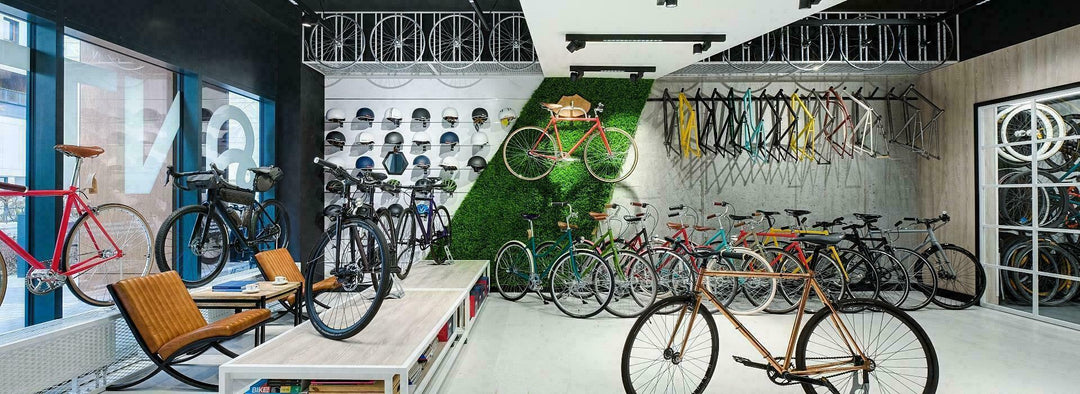
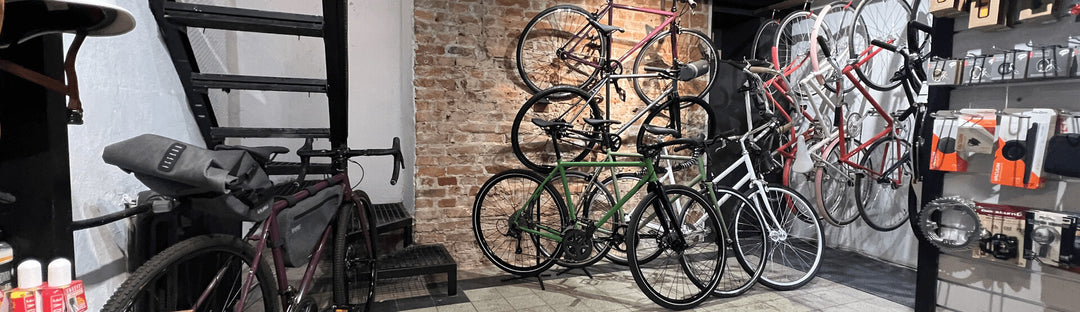
We're in Vienna, so wherever we go, good coffee is always within sight. The same goes for great food. But there are a few places made just for cyclists (photos from these places are at the end of the article):- Radlager (sounds cool and exotic, even though it's our local bike hub) – a place with good coffee and beer. Not to mention a collection of vintage bikes.
- The concept of combining coffee or food with a shop is no longer new. But few places are as sophisticated (and I'm not just talking about the cuisine) as Gihisallo.
- And finally, a shop/service/coffee place that gives us complexes when it comes to the quality of the interiors, i.e. Veletage
Radlager
Ghisallo
Veletage


Rewelacyjne zdjęcia:) A co do samego Wiednia, to faktycznie jest to miasto wręcz stworzone do przemierzania go na rowerze. Austria jest jak dla mnie numerem 1, jeśli chodzi o infrastrukturę rowerową (i nie tylko:)
Leave a comment