

The derailleur is a crucial element that helps with climbing hills and makes riding a bike easier. We often compare this part of the drivetrain to a car's gearbox. Before buying our bike, we often also face the challenge of choosing the right derailleur. In addition to the traditional derailleur, we can also find versions built into the hub. Standard derailleurs, also known as external derailleurs, are divided into front and rear. They also have additional sprockets. Models hidden in the rear hub are called "planetary derailleurs," and I will try to describe this type of derailleur here, in terms of its advantages and disadvantages. We use them on our bikes and, unlike many repair shops, we regularly service them. Hub derailleurs are not magic!
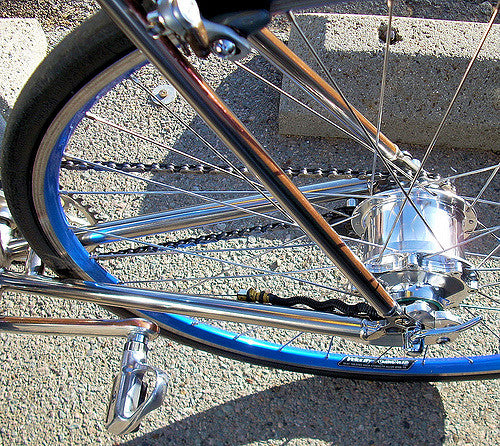
 A gear hub with a coaster brake. On the right, you can see the brake arm mounted to the frame, which allows the wheel to be locked.
Another key advantage is that changing gears doesn't have to be done while riding, but can also be done while stationary or at traffic lights. Importantly, the device's simplicity allows for convenient and, above all, simple operation, with only one shifter to change gears. These derailleurs are considered maintenance-free, so it's difficult to find a repair shop that knows them well. However, it's important to remember that a season-long inspection and oil or grease change is a reasonable minimum. It would certainly be simpler and cheaper to visit a repair shop every season than to buy a new derailleur, especially since this requires re-bracing the sprocket .
The most popular planetary hubs
A gear hub with a coaster brake. On the right, you can see the brake arm mounted to the frame, which allows the wheel to be locked.
Another key advantage is that changing gears doesn't have to be done while riding, but can also be done while stationary or at traffic lights. Importantly, the device's simplicity allows for convenient and, above all, simple operation, with only one shifter to change gears. These derailleurs are considered maintenance-free, so it's difficult to find a repair shop that knows them well. However, it's important to remember that a season-long inspection and oil or grease change is a reasonable minimum. It would certainly be simpler and cheaper to visit a repair shop every season than to buy a new derailleur, especially since this requires re-bracing the sprocket .
The most popular planetary hubs
Hub derailleur, also known as planetary gear
The planetary gear shifter is hidden in the rear hub, so all visible components are enclosed, protecting them from dirt and damage like a traditional derailleur. Furthermore, adjusting a hub derailleur is usually very simple – simply adjust the special indicators in the selected gear (usually in the middle of the range) so that they align due to cable tension. A gear hub with a coaster brake. On the right, you can see the brake arm mounted to the frame, which allows the wheel to be locked.


Zgadza się, są praktycznie bezobsługowe. Ale z drugiej strony naprawa bywa trudniejsza a w skrajnych przypadkach niemożliwa. Dużo zależy także od tego jak są traktowane :)
Witaj, czy to prawda, że przerzutki w piaście są o wiele bardziej wytrzymałe na zużycie?
Podobno są na wieki. Też bród i inne zanieczyszczenia ciężko się do nich dostają.
Pozdrawiam
wiadomo, przezorności nigdy dość :)
Ale posmarować warto, przed zimą. Robię to w przerzutce 7bieg. SRAM po położeniu roweru np. na skrzynkach i wkropleniu do piasty ok.10 kropel Hipolu. Na sezon to dość, bo będzie zalewać opony;-)
Leave a comment