

Bicycle brakes - an important part of the bike!
We've written about this topic on our blog before, but things have changed considerably over the past two years, so we're revisiting the topic. And not just for that reason. Every element of a bicycle is important, because each component serves a specific function and shouldn't be forgotten. However, the brakes deserve the most attention, as they are responsible for our safety.That's why it's worth updating your knowledge about them and occasionally considering replacing the entire braking system. Admittedly, this isn't always a simple matter, and sometimes, due to technological reasons and part compatibility, it's simply impossible. For example, if your bike has V-brakes and you want to upgrade to disc brakes, you might need to replace many parts, including the wheels and hubs. Furthermore, older frames may not even have a brake caliper mount.
In the case of city and road bikes, where disc brakes are becoming increasingly popular, the situation can be even more challenging. Replacing old V-brakes with newer ones shouldn't be a problem. Moreover, if someone wants to upgrade their bike's brakes, there are eight types of braking systems to choose from. Therefore, it's worth knowing all the available bicycle brake types and choosing the ones that best suit their bike.
see also - Hydraulic brakes on a bicycle - which are the best?
What type of brakes?
As we mentioned above, there are eight types of brakes available on the market, but three are the most popular. Some are no longer popular, outdated, or unusual, but each has its pros and cons. When it comes to brakes on an older bike or one you're building from scratch, remember that brakes are your safety. It's not worth skimping on the cheapest options, especially those of questionable quality. Of course, everything depends on the intended use and type of bike, but sudden braking can happen when you least expect it, so every bike needs functional brakes.
V-brake brakes
We'll start with them because they're the most popular and most common braking system. These universal, easy-to-use rim brakes are found on older bikes as well as simpler touring bikes, city bikes, and mountain bikes. They're lightweight, simple, inexpensive, and quite durable, but they're not suitable for road or performance bikes.
Disadvantages - Advantages
Advantages include low price, weight, and ease of use, installation, and adjustment. A little practice in using these brakes is enough to fix minor problems on the road. These brakes are suitable for everyday riding around town or up slight hills. They are primarily intended for recreational riders. The biggest drawback of these brakes is their effectiveness in poor weather and challenging conditions, when braking efficiency drops dramatically. Furthermore, as with all rim brakes, they cause rim wear.
Disc brakes
Colloquially known as disc brakes, they're a long topic, but we'll try to briefly outline their structure and types. Disc brakes operate on a completely different principle than rim brakes. Disc brakes feature a brake disc mounted to the hub, which is pressed by the pads. Importantly, these types of brakes require special hubs with mountings for the brake disc. Disc brakes are divided into two types: mechanical and hydraulic.
Mechanical or hydraulic.
In the case of mechanical brakes, the caliper is activated by a steel cable, while in the case of hydraulic brakes, brake fluid is used. Hydraulic brakes are becoming increasingly common these days, although cheaper bike models, especially MTBs, still feature mechanical brakes. While this is a feature of the cheapest bikes, it's worth remembering that high-quality mechanical brakes are a better solution than the cheapest, questionable hydraulic models.
Pros and cons
When investing in a new bike or buying a ready-made brake set for a folding bike, it's definitely worth investing in good quality hydraulic brakes. They provide excellent stopping power and modulation, allowing you to select the right amount of force for the conditions and needs. Importantly, disc brakes operate reliably in all conditions, even in rain or mud. They guarantee full braking power at all times. The main drawback is the price. Disc brakes are much more expensive than V-brakes, and some bikes don't accept them (e.g., lack of brackets in the frame or fork). Furthermore, they are much heavier, making adjustments and repairs on the road very difficult. If a hydraulic hose is damaged, repair can only be achieved with the right tools.
Check also - How to replace V-brakes yourself
Dual Pivot road brakes.
Dual Pivot, or road rim brakes. Their greatest advantages include easy modulation of braking force, aerodynamics, lightweight construction, and a design that prevents the fork and fork from being pushed apart – they are mounted at a single point above the wheel. Another significant advantage is their reasonable price. As for the disadvantages, it's worth noting their relatively high complexity, making adjustment and maintenance more difficult. And, like all brakes of this type, they also wear out the rim.
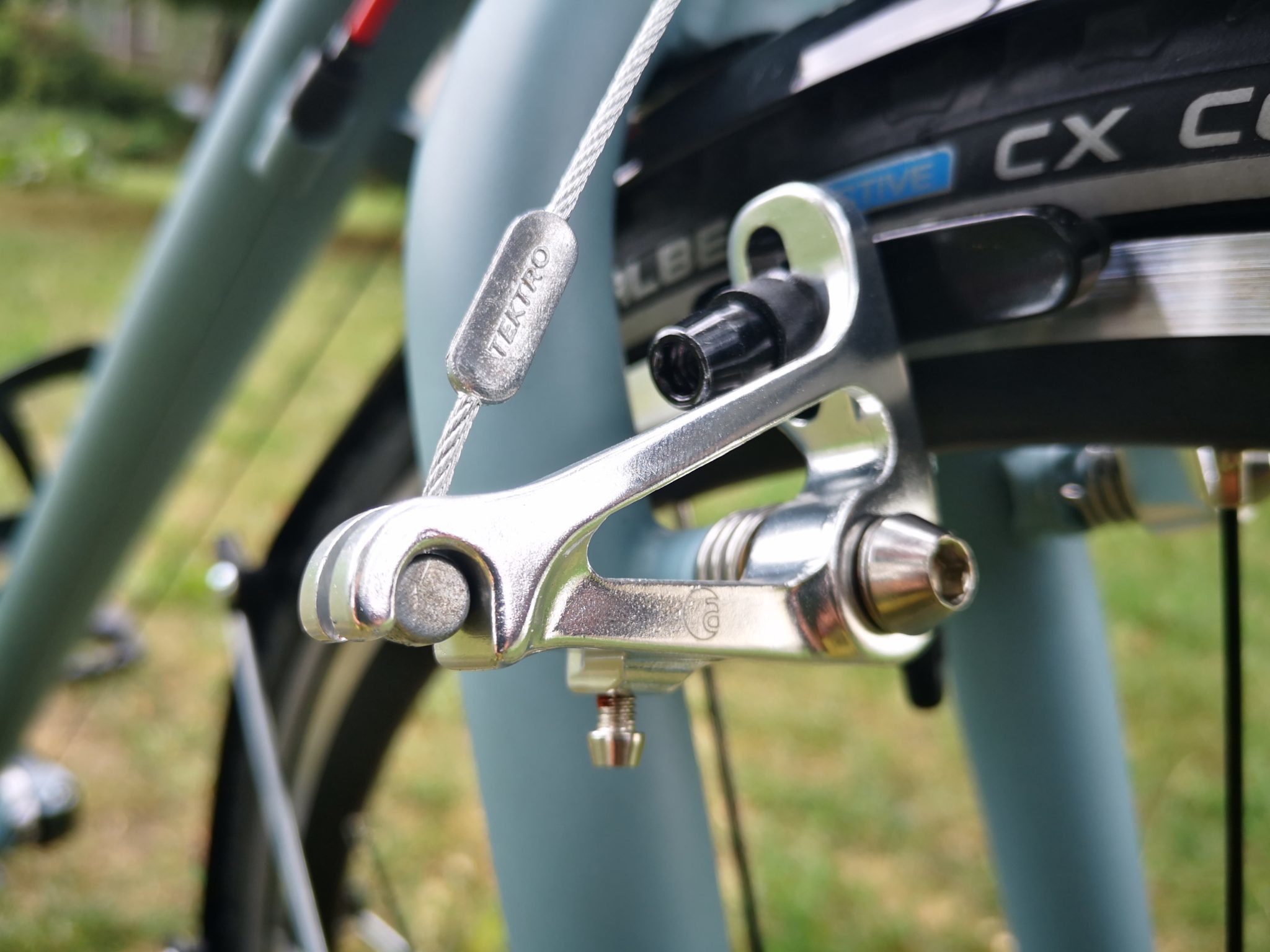
Cantilever brakes.
While this type of brake is a relic of the past, it has many supporters and admirers. This system is a kind of predecessor to the V-brake and was popular on many bikes – from road bikes to mountain bikes. Currently, this type of brake can be found on city bikes and cyclocross bikes. We also install this type of solution on trekking bikes, and you can also buy them in our online store . Its many advantages include a simple design, easy adjustment, and ease of use. Importantly, this design allows for the installation of even very wide tires. The only issue is that the braking power is slightly weaker than with V-brakes, although that's still debatable.
Roller brakes.
This is a less common type of braking system. It is primarily used on city bikes, and the operating principle is quite simple. The rollers are hidden in a special drum. During braking, they press against the drum surface. These brakes are not suitable for other bikes because the braking force offered is relatively low. An advantage is their relatively low failure rate, as the brakes are housed in a sealed structure that is insensitive to water, sand, etc., and therefore less susceptible to failure. Unfortunately, their high weight and complex design make them unsuitable for long rides.
Coaster brakes.
Coaster brakes are the kind of brakes that everyone has probably encountered at some point. The brake is mounted in the rear hub, and to brake, simply press the pedals in the opposite direction. This solution is most often found on simple children's bikes, city bikes, but also in models with multi-speed hubs. The advantage is one undeniable: intuitive operation, so even a child can quickly learn how to use them. Furthermore, the brake is insensitive to weather conditions and practically maintenance-free. The only limitation is its power. It is quite limited, as are its durability and temperature resistance. And one very important thing! If the chain breaks, there's no brake.
Hydraulic rim brakes.
Finally, here are some interesting and rare features: Hydraulic rim brakes were developed by Magura. They operate similarly to V-brakes, but instead of a steel cable, hydraulic lines carrying brake fluid are used. Braking power is incomparably higher than that of standard V-brakes and will satisfy demanding users. Unfortunately, there's a trade-off. With increased power comes increased rim wear. Does it have any drawbacks? Three, to be precise: heavy weight and a high purchase price. Repairing and adjusting such brakes is not the easiest task.
U-brake brakes.
This interesting feature originated from BMX bikes. While they can be found on cheaper models today, they have been replaced by newer, more effective solutions. Their primary advantages are their simple design and price. However, they are difficult to obtain, and their braking power leaves much to be desired.
What to pay attention to when choosing.
We've briefly presented the classification of bicycle brakes above. This is brief, as it's not exhaustive. When choosing, there are a few other factors to consider. For example, the type of disc brake mounting. Whether the IS standard is used, which involves bolting the disc to the hubs. Or the Center Lock standard, where the disc is secured with a properly selected nut instead of screws. This significantly shortens and simplifies the installation process. It's also worth considering the material used in the brake pads. You can choose from organic, metallic, and semi-metallic models. Which one to choose depends on your intended use and budget.


Leave a comment