


Do you enjoy city trips and discovering new places? Cycling doesn't make us locals, but neither do we become ordinary tourists! We also gain the opportunity to see the city from a different perspective. Not to mention the health benefits. That's one of the reasons we write short, practical mini-guides dedicated to European capitals (the most bike-friendly ones, of course). We also plan to write articles about larger Polish cities. Our first post was about Vienna. This time, we're exploring the world of German and heading to the capital of Germany.

 Below, I've also included a handful of hotel suggestions. What they all have in common is proven quality, good food, and openness to the city. The latter is important to me because we're where the locals live, not in a separate, artificial zone intended exclusively for visitors.
Suggestions:
Below, I've also included a handful of hotel suggestions. What they all have in common is proven quality, good food, and openness to the city. The latter is important to me because we're where the locals live, not in a separate, artificial zone intended exclusively for visitors.
Suggestions:


 For someone visiting from Poland, it might be surprising how many tourists are drawn to attractions that, in various ways, connect with relatively recent history. Of course, it's impossible not to stop at the monument dedicated to the murdered Jews (it's a shame that our Polish monument-mania takes on such repetitive and traditional forms that have long since ceased to inspire any reflection). I grew up during the communist era, so I have no desire to spend time in a museum dedicated to the Trabant car or to queue for a photo at a recreated "Checkpoint Charlie" for tourists. Perhaps it's simply a generational issue. As an aside, it's impressive how the Germans were able to cleverly "market" their way into our liberation from Soviet domination. Walking the streets of Berlin, we have the overwhelming impression that it was there, with the fall of the Berlin Wall, that communism ended in this part of Europe.
 By Dieter Brügmann - photo taken by Dieter Brügmann on 2005-03-28, CC BY-SA 3.0, https://commons.wikimedia.org/w/index.php?curid=611043
 While Tempelhof is located practically in the center of the city, reaching Glienicke Park , located to the southwest, requires about an hour of pedaling (assuming you're starting from near the city center). The route passes through some of Berlin's greenest areas, as evidenced by the name of the district we're passing through (Grunewald). We arrive not at just one park, but at a whole complex that stretches all the way south to Potsdam. And this entirepark and palace complex is a UNESCO World Heritage Site.
 https://commons.wikimedia.org/wiki/File:Berlin_Spreepark_UAV_04-2017_img1.jpg#/media/File:Berlin_Spreepark_UAV_04-2017_img1.jpg
 Well, Berlin's cycling culture has been thriving for years. There are a few places we're truly envious of:
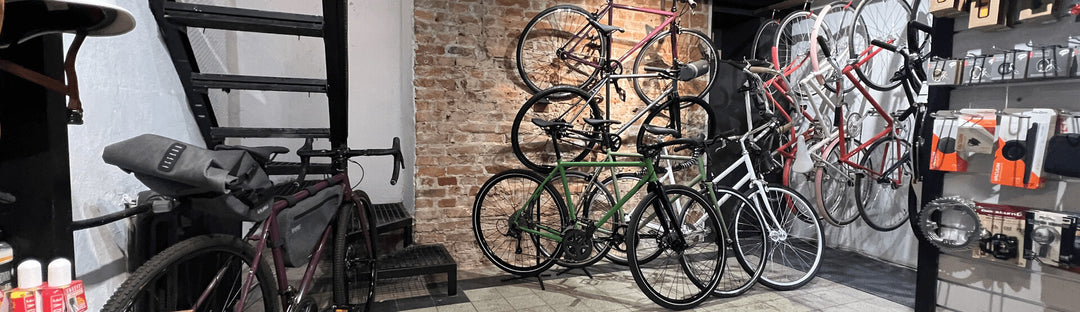
1. One of the first places on the market that serves good coffee and makes even better bikes is Standert , located in the center of Mitte.
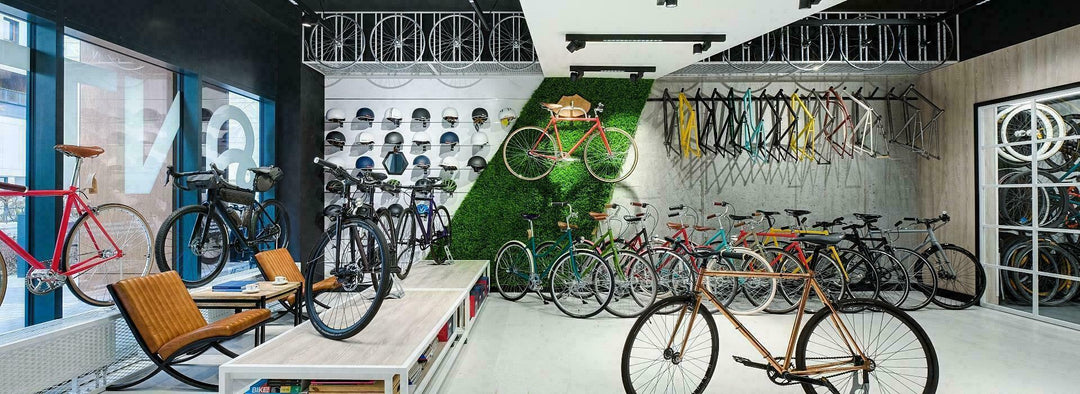
2. A much newer venture, impressive in its scale and quality of interior finishing - The Gentle Jaunt Bike Cafe .
3. If you like cycling history and vintage bikes, you can't miss the Steel Vintage Bike Cafe. It seems that there used to be a bicycle repair shop here, but today the bikes are mainly (or only) decorative.
4. However, the same cannot be said about the proposal from the point above about Vintage Velo Berlinn , which is completely serious about what its name says - it offers carefully restored stylish old racing bikes.
Well, Berlin's cycling culture has been thriving for years. There are a few places we're truly envious of:
1. One of the first places on the market that serves good coffee and makes even better bikes is Standert , located in the center of Mitte.
2. A much newer venture, impressive in its scale and quality of interior finishing - The Gentle Jaunt Bike Cafe .
3. If you like cycling history and vintage bikes, you can't miss the Steel Vintage Bike Cafe. It seems that there used to be a bicycle repair shop here, but today the bikes are mainly (or only) decorative.
4. However, the same cannot be said about the proposal from the point above about Vintage Velo Berlinn , which is completely serious about what its name says - it offers carefully restored stylish old racing bikes.
 Berlin also has several local producers of interesting accessories:
Why Berlin by bike?
In 2001, during the election campaign, Klaus Wowereit coined the slogan: "Berlin is poor, but sexy." This landed him in the mayoral seat for 14 years. Since then, the city has changed incredibly, but Berlin remains "sexy." This makes it unique, and not just among German cities. A dozen or so years ago, such opinions could be taken literally. To this day, the city attracts those seeking ecstatic entertainment of all kinds—after all, it was here that "techno" music was born. But today's "sexiness" is more about the openness and diversity of this place. Whether you're looking for artistic thrills, interested in history, dreaming of a great concert, or simply want to spend time on the beach, in a park, or enjoying great food—Berlin has something for you. And then there's the internationality, openness, and tolerance of this place, which is especially surprising to those who have experienced Germany outside of the city. A few additional facts for those who still have doubts:- Length of bicycle paths: 620 km
- Number of sunny hours per year: 1625
- And if it's not sunny? Over 180 museums, 130 cinemas, and 440 art galleries
- Place in the ranking of the best cities for cyclists (The Copenagenize Bicycle Friendly Cities Index 2017 ) – 10
- Place in the ranking of the best cities to live in the world according to Monocle magazine (Top 25 liveable cities 2016 ) – 2
How to get to Berlin (but probably not by bike)?
For simplicity's sake, I'll assume we're starting from Warsaw. We have four realistic options, aside from having enough vacation time to get there on our own two wheels:-
- Currently, only LOT operates flights to the German capital. Until recently, AirBerlin offered convenient connections (up to three a day), but unfortunately, this was short-lived. The regular price for a round-trip ticket is around 800-100 PLN, and the flight takes less than an hour. Tickets are sometimes available at better prices, so it's worth keeping an eye out for promotions. If you're accumulating miles in the Miles&More program, it's worth checking this website: http://www.lot.com/pl/pl/promocja-milowa . If you're lucky, you can travel across Europe for 7,000 miles (instead of the standard 35,000). However, this is only for the lucky ones or those without burdensome family or work commitments, as these promotions cover flights on specific dates and are announced only 1-2 weeks in advance. In any case, we land at Berlin Tegel Airport, where we're reliant on buses or taxis (about €25) to get to the city center. Berlin's famously beautiful and modern BER airport, which is supposed to replace all the old ones, is experiencing further delays and currently doesn't even seem to have an official opening date.
- Train. There are three trains daily, and by purchasing in advance, you can get tickets at a special price of €39.90 (one-way). However, be warned: these tickets are only available on the Deutsche Bahn (German Railways) website - https://www.bahn.de/p/view/angebot/index.shtml?dbkanal_007=L01_S01_D001_KIN0014_top-navi-tickets-angebote_LZ01 . Tickets can, of course, be purchased in Poland at station ticket offices. Interestingly, although the entire ticket purchasing process on the Deutsche Bahn website is fully online (payment by card or PayPal), you receive your tickets by post within a few business days. So, it's not a good idea to plan a last-minute weekend in Berlin this way. The journey takes a little over six hours and we reach the Hauptbahnhof station. Unless you want to relive the flushed emotions of arriving in a somewhat better world under the communist era, then we get off at Ost Bahnhof. Important information: the train allows you to transport your own bicycle!
- The third option, traveling by car, will take approximately 5 hours – provided we respect speed limit signs. Aside from the frustration of the numerous toll booths on the section from Łódź towards the border, the road is very comfortable, especially since it has also been modernized on the German side. An advantage of this type of transportation is the ease of transporting your own bike.
- The longest journey awaits those who choose the bus (FlixBus seems to be the only option these days), spending about nine hours. However, the bus arrives at Zentrale Omnibus Bahnhof (or simply Berlin ZOB), which is conveniently connected to the rest of the city by metro. Buses to Berlin offer laptop charging stations and Wi-Fi, and most importantly, they're cheaper than the train (even at a special price), with tickets starting from 100 PLN.
Where to stay in Berlin?
Although city officials are officially trying to restrict the ability to rent apartments through AirBnb, we can currently choose from over 2,000 listings on their website. If you're traveling in a larger group and don't want to spend a fortune on hotels, renting an apartment or flat is the best option.
Below, I've also included a handful of hotel suggestions. What they all have in common is proven quality, good food, and openness to the city. The latter is important to me because we're where the locals live, not in a separate, artificial zone intended exclusively for visitors.
Suggestions:
- Cosmo Hotel Berlin. Of the over 100 hotels I've stayed in around the world, none offers a better breakfast. Whether you're a strict vegan or can't imagine breakfast without scrambled eggs and bacon, I guarantee that spending so much time in a restaurant in the morning might make it difficult for your sightseeing ambitions to make it through to your consciousness.
- 25h Hotel (or simply Bikini Hotel) is a great option for those who enjoy nightlife and appreciate comfort. On the top floor (with an incredible view of the Tiergarten and the zoo), there's a cult restaurant and something bordering on a club/bar. While people from the city queue on weekend evenings, we, feeling a sense of well-deserved superiority, take a separate, internal elevator to the top. Nearby is a small shopping center and a cinema. Best of all, we get to ride (unfortunately, not for free!)
- Orania.Berlin. Currently my favorite place. Unfortunately, it's also the most expensive. A bit off the beaten track, far from the most popular tourist attractions. But it boasts beautiful surroundings, stunning architecture, and some of the most luxurious rooms I've ever stayed in.
- Casa Camper Berlin. Those who know and love their shoes may be surprised, as it seems they're the same company. A very conveniently located hotel in Mitte. The top floor boasts a traditional bar and great views of the city. An interesting concept, as you bring your own snacks and alcohol and leave money for them – the ultimate self-service experience.
Berlin by bike, but where does the bike come from?
There are plenty of bikes here (statistically, 7 for every 10 residents), so you'll easily find a few bikes for tourists! Berlin has had a long-established network of city bike rentals, launched by a company also known in Warsaw (Nextbike, which was originally the sole owner of the Warsaw system). The Nextbike network covers the entire city, offering over 5,000 bikes. The first 30 meters cost €1, the next €1.5 meters, and a maximum of €15 for 24 hours. Interestingly, if you open the Nextbike app on your phone and connect it to your Deezer account, the first 30 minutes are free. Deutsche Bahn (German Railways) also has its own platform ( https://www.callabike-interaktiv.de/de ), offering 15,000 bikes in over 45 cities in Germany. "Call a bike" rentals have gained a powerful partner in Lidl, and despite the name change, there are now more of them. Most importantly, these bikes can be rented and left directly on the street (in a specific area). There are also several relatively new alternative systems based on a philosophy different from "classic" city bikes. Bikes can be unlocked and left at dedicated stations. In "Stationless Bike Sharing" systems, you simply find a bike (you need to install a dedicated app, but this is currently standard for all systems) in the city. Of course, you leave it the same way. In Berlin, you can choose from O-Bike and Mobike , and there are also bikes from the Danish company Donkey Republic. Prices are competitive; for example, a bike at O-Bike costs €1 per 30 minutes (a €79 deposit is required, collected by credit card or PayPal). In addition to public rental systems, there are many shops and companies that organize tours and rent equipment. Select hotels also offer bikes, but prices can be unattractive (sometimes even over €30 per day). A few private rental options are listed below, with the caveat that not all of them were tested: 1. Take a Bike - the longer the cheaper, i.e. a decent bike for the whole week for about 8 Euro a day 2. Fahrradstation - several places in the city, bikes for one day from 15 Euro 3. Rent a bike 44 - the cheapest option, from 4 Euro per day!How to spend a weekend in Berlin by bike?
Berlin is made for cycling. Even most traditional guidebooks recommend this method of getting around the city. Cycle routes cover the entire city, creating a comprehensive, interconnected transport network. Of course, the fewest dedicated cycle paths are in the city center (Mitte), but even there you can ride very safely. The cycle paths vary greatly in character – as in Warsaw, the varying stages of infrastructure development are evident. Unfortunately, there are still many sections with cobblestones or even slabs, but all new routes have comfortable asphalt and various amenities (separate traffic signals, locks, etc.). Cycle routes are also quite common on streets with heavy car traffic (usually separated only by painted lanes). There are also numerous slow-moving zones, but unlike in Vienna, they tend to be outside the city center. Unlike Vienna, there are also fewer one-way streets with bidirectional traffic. While drivers in Berlin seem to generally obey the rules, cyclists seem exempt. Older people behave responsibly, but for younger people, there are no red lights, no obligation to ride on designated routes, and so on. This is interesting because the fines for violating cycling regulations are quite strict (running a red light can cost from €45 to as much as €100, and the stupid brother of a traffic light or riding two bikes side by side can cost €15!) Finally, an important note for those who haven't taken proper care of their fitness: the German capital is as flat as a table – even the bridges over the numerous branches of the Spree or the canals don't have any steep inclines. Although the city is quite vast, it's impossible to get too tired moving at a tourist pace.
A cycling weekend in Berlin – culturally
The suggestions for what to see and do won't aim to encompass the most important attractions or fit into any particular logical whole. These will be purely individual selections, informed by short but regular visits over the last 10 years.
For someone visiting from Poland, it might be surprising how many tourists are drawn to attractions that, in various ways, connect with relatively recent history. Of course, it's impossible not to stop at the monument dedicated to the murdered Jews (it's a shame that our Polish monument-mania takes on such repetitive and traditional forms that have long since ceased to inspire any reflection). I grew up during the communist era, so I have no desire to spend time in a museum dedicated to the Trabant car or to queue for a photo at a recreated "Checkpoint Charlie" for tourists. Perhaps it's simply a generational issue. As an aside, it's impressive how the Germans were able to cleverly "market" their way into our liberation from Soviet domination. Walking the streets of Berlin, we have the overwhelming impression that it was there, with the fall of the Berlin Wall, that communism ended in this part of Europe.
Museum Island
If it's not the DDR or the Stasi, then what? First of all, we head to Museum Island, where within a few hundred meters we have several extraordinary museum institutions. I will invariably recommend a visit to the Pergamon Museum first and foremost. From today's perspective, one might have different opinions on the idea of chipping away at a piece of a city stone by stone and transferring it all to another. Nevertheless, this happened in the 19th century, and today we can admire something unique – fragments of ancient buildings and, above all, the famous Great Altar of Zeus (Pergamon is a city currently located in Turkey, and yes, that's where parchment was invented). Unfortunately, admiring it is currently necessary to be cautious – the museum is undergoing a comprehensive renovation (until 2023), and not everything is open to visitors (however, a temporary pavilion is planned to open nearby during the renovation). Before visiting, be sure to check what's currently available. While, to put it simply, what we'll find on Museum Island is the equivalent of our National Museum in Warsaw, the exhibitions at the Berlin Hamburger Bahnhof will be the equivalent of... the Museum of Art in Łódź. And not just because Warsaw (which is hard to believe) hasn't developed its own museum of contemporary art. One of the most important avant-garde artists to fill the Berlin institution's spaces is Joseph Beuys – the same one who, out of a sense of moral responsibility for World War II, donated a significant portion of his own works to the Łódź institution!Exhibitions and more
A good idea for those interested in what Berlin's museums and galleries have to offer is to keep up with current exhibitions and events. I admit, I don't do this very often, especially when I know I won't be able to make it to Berlin anytime soon, because the abundance and choice make me feel like an immigrant (yes, I know Muslim militias are spreading terror there and kebabs are replacing currywurst… but I still envy them all). I'd like to recommend two more attractions that might seem daunting at first glance due to their overcrowding. I'm talking about a cruise on the Spree River – a perfect way to rest your legs over a beer and see the city from a different perspective. It's also nice to take a break (sometimes) and climb the famous TV Tower at Alexanderplatz. The tower itself is also an excellent navigation aid, as it's practically in sight when you're cycling around Berlin. And since we're on the subject of attractions, I suggest a trip to see up close the vestiges of an idea that, in the eyes of Hitler and his court architect, Albert Speer, was meant to overshadow everything else. We're talking about the massive triumphal arch (it was supposed to be three times larger than the one in Paris). To this day, only a large concrete structure remains, intended to test the assumptions of erecting such a heavy structure on rather marshy ground.
By Dieter Brügmann - photo taken by Dieter Brügmann on 2005-03-28, CC BY-SA 3.0, https://commons.wikimedia.org/w/index.php?curid=611043
A cycling weekend in Berlin – if you prefer nature
It may not be the most obvious choice, but you can also go to Berlin to spend time cycling in green surroundings. Whenever I visit the city in spring or early autumn, a must-do is a drive around the former Tempelhof Airport (yes, this is the same place where pilots chose freedom during the communist era). When the decision was made to close the airport, residents voted in a referendum to simply open the area and make it accessible to everyone. The ultimate fate of this place is still being debated, but for now, it's a space for social activities (mini gardens, meetings, picnics) and activities (bicycles, rollerblading, modeling, etc.). On sunny weekend days, thousands of people use the former taxiways and takeoff areas for rides, spreading blankets, grilling sausages, and, of course, enjoying copious amounts of beer.
While Tempelhof is located practically in the center of the city, reaching Glienicke Park , located to the southwest, requires about an hour of pedaling (assuming you're starting from near the city center). The route passes through some of Berlin's greenest areas, as evidenced by the name of the district we're passing through (Grunewald). We arrive not at just one park, but at a whole complex that stretches all the way south to Potsdam. And this entirepark and palace complex is a UNESCO World Heritage Site.
A Little Bit of History
If we want to indulge in a moment of historical reflection along the way, we stop at the villa where the decision on the "Final Solution of the Jewish Question" was made. I recommend this quasi-documentary film , which shows how a group of dignitaries and officials reached the decision to exterminate the Jews in 1941. The exceptional Kenneth Branagh plays Reinhard Heydrich . The villa now houses a museum. A little further on, we can feast our senses on the attempt to build a better version of Versailles, namely Sanssouci Palace. But since it's impossible to truly escape the history of World War II in this area, we find Cecilia Palace nearby, where Churchill (later Atlee), Truman, and Stalin approved the shifting of our country's borders during a series of meetings that became known as the Potsdam Conference.Pearls
Those who know Berlin even a little may be surprised that I haven't mentioned the Tiergarten here. I don't recommend cycling there – you're practically constantly surrounded by throngs of tourists, if not cars. Of course, it's sometimes convenient to navigate its alleys using public transportation, but in my opinion, the experience is mediocre. We also have a suggestion for the ambitious: 160 km in one day. This route follows the route of the wall that divided the city until 1989. More details here: https://www.berlin.de/mauer/en/wall-trail/ Of course, you can choose shorter sections – those far from the city center, which would be difficult to reach without a special reason, are especially enjoyable. Finally, a curiosity: the abandoned Spreepark amusement park. It's long been closed, but those who want to will find a way in. The whole thing has a slightly surreal feel, so it's no surprise it served as a set for several films.
https://commons.wikimedia.org/wiki/File:Berlin_Spreepark_UAV_04-2017_img1.jpg#/media/File:Berlin_Spreepark_UAV_04-2017_img1.jpg
Cycling weekend in Berlin – what about shopping?
There's no point in elaborating on the countless galleries (including the famous KaDeWe) or shops of all the international and local brands. I can't pretend I'm particularly interested in such offerings. But it must be admitted that, for example, if we insist that Rimowa makes the lightest suitcases, we'll definitely find the one we want at the company's Berlin store. Nevertheless, I do visit these few places regularly:- As a child, I spent my evenings building models (in plastic, paper, or modeling clay). So, for the sheer pleasure of looking and touching, I head to the Modulor store. See for yourself, isn't it beautiful? https://www.modulor.de/feinwerkzeug-set-nr-2-7er-set-in-verschliessbarem-weichplastiketui.html
- Manufactum . At first glance, it looks like an ordinary home furnishings store. But that's just a facade, because it's all about the excellent craftsmanship, quality, and delightful creativity of the items offered here. Even though I don't have such needs, I've never left this store empty-handed ( h
- Merheineke Markthalle , or Berlin's proto-baskets, has normal proportions, meaning more cold cuts and cheese vendors than tapas and sushi. On weekends, there's also a flea market nearby.
Are you a bit crazy about bikes? You can't miss these places in Berlin!
Well, Berlin's cycling culture has been thriving for years. There are a few places we're truly envious of:
1. One of the first places on the market that serves good coffee and makes even better bikes is Standert , located in the center of Mitte.
2. A much newer venture, impressive in its scale and quality of interior finishing - The Gentle Jaunt Bike Cafe .
3. If you like cycling history and vintage bikes, you can't miss the Steel Vintage Bike Cafe. It seems that there used to be a bicycle repair shop here, but today the bikes are mainly (or only) decorative.
4. However, the same cannot be said about the proposal from the point above about Vintage Velo Berlinn , which is completely serious about what its name says - it offers carefully restored stylish old racing bikes.
Berlin also has several local producers of interesting accessories:
- Expensive but very interestingly made (see e.g. http://www.gramm-tourpacking.com/pizza-bag ) bicycle panniers from Gramm Tourpacking
- Much more affordable, handmade bags in the city, mainly courier bags from Bag Jack


Sizler de güvenilir ve kazançlı bahis deneyimleri yaşamak için yapmanız gereken şey oldukça basittir. piabella casino adresi üzerinden üyelik işlemlerinize başlayarak bahis deneyimlerinize başlayabilirsiniz.
ilbetgir adresi Türkiye’de en çok tercih edilen sitesidir. Siz de ilbetgir’e gelerek keyifli ve kazançlı bahis deneyimi yaşayabilirsiniz.
Son zamanlarda pek çok kişi bahisin kaliteli ve güvenilir adresi olan elexbet güncel giriş adresini tercih etmektedir. Sizlerde bağlantı üzerinden vakit kaybetmeden elexbet güncel giriş ailesinin bir parçası haline gelebilirsiniz.
Świetny poradnik! Poirytowala mnie tylko czesc “jak dojechac” bo brzmi jakby jedyny dojazd do Berlina z Polski byl z Warszawy (ale nie jest to nigdzie napisane).
Pojechaliśmy, przejechaliśmy, wróciliśmy, napisałem ;). Podrzucam, może w czymś się przyda. Dzięki za chęć pomocy – ostatecznie tego rowerowego miejsca z kiedyś niestety nie znalazłem. Z pozdro :)
https://www.znajkraj.pl/berlin-na-weekend-szlak-rowerowy-muru-berlinskiego
Leave a comment