

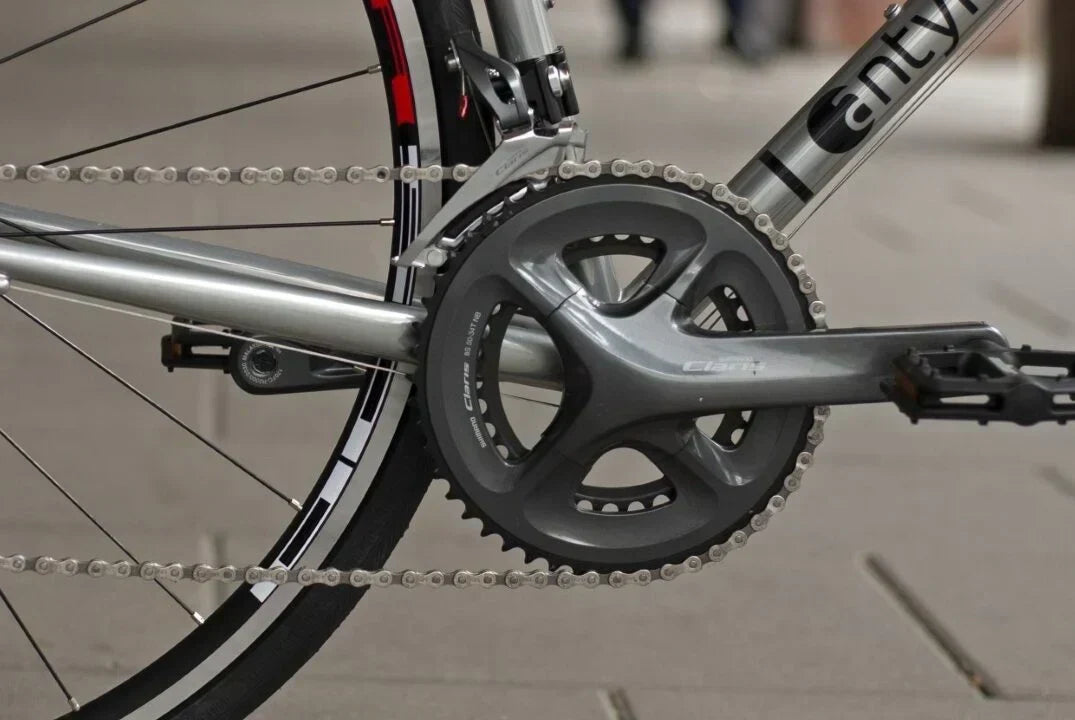
Front Derailleur Adjustment - A Guide for the 2025 Cyclist
While more and more bikes—especially gravel and mountain bikes—are ditching the front derailleur in favor of a simpler single-speed setup, this component still thrives on road bikes, cross-country bikes, trekking bikes, and older mountain bikes. If you use a two- or three-speed drivetrain, properly adjusting your front derailleur is essential for a comfortable ride. Otherwise, you'll encounter chain rub, grinding on slopes, difficulty shifting onto a large cog… or even worse, the chain dropping into the frame.
The good news? This mechanism is still quite easy to set up yourself—as long as you approach it methodically. And we'll show you how.
Read Now - Adjusting Your Bike's Rear Derailleur - 2025 Guide

🔍 To start: make sure it's worth adjusting at all
Before you touch any screw, take a look at:
- drive cleanliness - mud and old grease are enemy number one,
- the condition of the cable and housings - a worn cable may not return, and even the best derailleur does not "snap back" in old housings,
- correct derailleur position - if the clamp is too low or too high in relation to the large chainring, no screw will help.
Additionally: check that the chain is not extremely worn and that the mechanism is not loose – these are common problems on older trekking and fitness bikes.
🧰 Tools needed
- Phillips or flat screwdriver (depending on the model),
- 5 mm Allen key for cable (usually),
- possibly a clamp wrench if something is significantly shifted,
- patience and good visibility - because everything happens low and close to the frame.

End of season? Check and take good care of your bike - How to care for your bike drivetrain in winter? Maintenance and cleaning
🔧 How to adjust the front derailleur step by step
1. Derailleur position relative to the large chainring
The derailleur's top plate should be about 1-3mm above the teeth of the large chainring and parallel to the chain line. If the derailleur is too high, it will be sluggish, and if it's too low, it may rub or drag the chain.
If it shifts, loosen the clamp (using the Allen key) and reset the derailleur. It's worth doing this once and for all, as incorrect physical positioning will invalidate any screw adjustments.
2. Working ranges - L and H screws
- L (Low) sets the boundary towards the smallest dial,
- H (High) regulates access to the largest shield.
Shift the chain onto the smallest front sprocket and the largest rear sprocket. Make sure the chain isn't rubbing against the inner cage plate. If it is, back off the L bolt slightly.
For the H screw: Set the chain to the largest chainring in the front and the smallest in the rear. If the chain falls outward when you try to shift onto the large cog, the H screw is too loose.

3. Cable tension
This tension determines whether the click of the shifter actually shifts the cog. If it doesn't engage the large chainring after the click, the cable is too loose. If the chain engages too early or rubs with every deflection, it may be too tight.
First, set the ranges. Then: tension the cable so that when it's secured to the bolt, it's taut, but not jerky. On some bikes, you can further refine the tension using the barrel on the shifter.

4. Gear ratio test and corrections
Once everything is set, click through the gears. The derailleur should engage the chain smoothly and quietly. Some systems (e.g., Shimano Sora, Claris, older Deore) may have a slight "tension" feature on the shifter—squeezing the lever without fully clicking allows the derailleur to shift diagonally.
Some bikes with a cross-brake chain will rub slightly—this is normal if it doesn't interfere with riding. But if it's too noisy, go back to the ranges or adjust the tension.

🚴 2025 and front derailleurs - still present
While single-speed drivetrains now dominate—especially on gravel, mountain bike, and city bikes—a front derailleur still makes sense where efficiency, range, and shifting precision matter. A two-speed road bike? A triple-chainring trek? A fitness bike with a Shimano Altus or Alivio drivetrain? Adjustability still makes a difference.
That's why it's worth knowing how to do it right - once and for all.
🔧 Don't want to wrestle with it?
The derailleur grinds, won't engage, and you've already tried turning the screws in all directions? It happens. Sometimes the cable is frayed, the hanger is slightly misaligned, or the housings simply won't return.
Leave it to us. At our bike shop in Mokotów and our showroom in Wrocław, we tackle these issues daily. We'll quickly set everything up properly—and you'll be back on the counter with no hassle.


Leave a comment