


Shimano's 2026 product range is broad, but it no longer follows a single, simple ladder from the cheapest to the best groupset. Road, gravel, MTB, and utility bikes are evolving somewhat independently today, and when choosing a drivetrain, its intended use is more important than its position in the catalog.
Claris, Sora, and Tiagra continue to function as the entry-level mechanical road groupsets. Above them, we have the 12-speed 105, Ultegra, and Dura-Ace. Gravel is developing its own GRX family, while Deore, SLX, Deore XT, and XTR remain for mountain bikes, and CUES is increasingly streamlining the segment of city, trekking, recreational, and lower-cost bikes with flat or road handlebars.

photo — Shimano
Read more: Which Shimano groupset should you choose for your bike?
Shimano road groupsets: from Claris to Dura-Ace
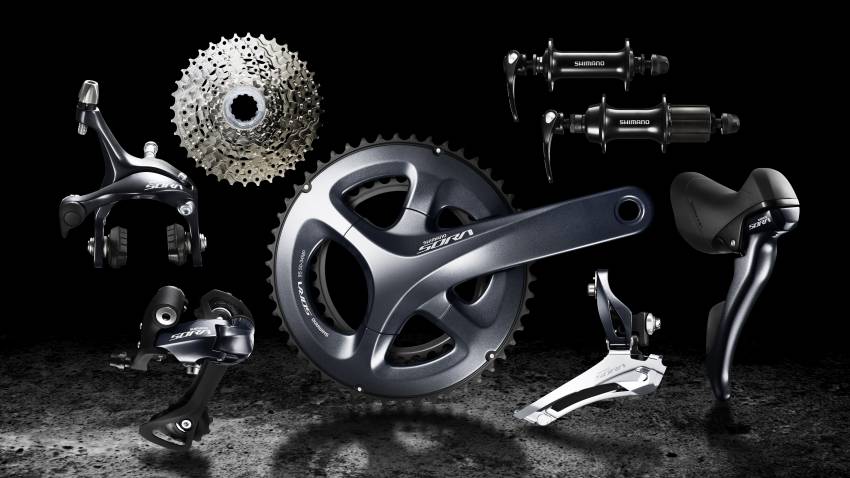
Claris R2000, Sora R3000, and Tiagra 4700
Claris, Sora, and Tiagra are well-known designs and far from new, but they are still present in Shimano's catalog and on new bikes.
Claris R2000 is an 8-speed mechanical drivetrain. It is simple, relatively inexpensive to maintain, and still makes sense for a first road bike, a recreational bike, or a faster city bike. Sora R3000 moves up to 9 speeds and offers slightly more configuration options. Tiagra 4700 is a 10-speed groupset that still works well for road, touring, and training bikes, especially where durability and reasonable running costs are more important than the latest technology.
In 2026, however, one must also look at these groupsets in the context of CUES. Shimano is developing this new platform for recreational and utility applications, but it has not withdrawn Claris, Sora, or Tiagra from the current catalog. It is rather a period where the older and newer segments of the range exist in parallel.
Shimano 105 R7100 and R7150
105 is now a much better benchmark for the modern road bike. The current generation has 12 rear gears and comes in both mechanical and electronic Di2 versions. The mechanical 105 R7100 is a good choice for someone who wants a modern drivetrain without batteries and electronics, while the Di2 variant uses the RD-R7150 rear derailleur and electronic shifting known from Shimano's more expensive groupsets.
For most regular road cyclists, 105 is the starting point for a modern training drivetrain that will last for years. Ultegra and Dura-Ace offer lower weight, more performance-oriented components, and a higher level of finish, but not everyone needs this for daily training.
Ultegra R8100 and Dura-Ace R9200
Higher up in the hierarchy remain the 12-speed Ultegra R8100 and Dura-Ace R9200. Both families are now primarily Di2 systems. Ultegra is a very strong choice for fast riding and performance training, while Dura-Ace remains Shimano's top road groupset, designed primarily for racing, low weight, and maximum efficiency.
The difference between 105 and the higher groupsets, however, does not come down to the number of gears. They all operate in the 12-speed world now, so as the price increases, we are paying more for weight, materials, shift speed, finish, and solutions taken directly from professional cycling.
Shimano CUES – a new order for utility bikes
CUES is one of the most important changes in Shimano's range in recent years. Instead of many separate families intended for city, trekking, recreational, or simpler off-road bikes, Shimano is developing a common platform with greater emphasis on durability, compatibility, and easier servicing.
A large part of the system is based on LINKGLIDE technology, designed for smooth operation and resistance to high loads. This is particularly important for e-bikes, trekking, and city bikes, where the drivetrain often operates under higher torque and is not always treated as delicately as the equipment on a lightweight road bike.
The most important change from the point of view of gravel and all-road bikes is CUES for drop handlebars. Shimano offers 9-, 10-, and 11-speed configurations, 1x and 2x drivetrains, and hydraulic disc brakes here. As a result, CUES is no longer a system limited to flat-bar bikes.

photo — Shimano
More about this group: Shimano CUES with drop bar shifters
CUES makes particularly good sense on a bike for daily riding, touring, commuting, light gravel, or bikepacking if durability and simpler maintenance are the priority. For performance gravel, Shimano still has the separate GRX family.
Shimano GRX – gravel, long routes, and bikepacking
GRX remains Shimano's main family designed specifically for gravel. We will still encounter older bikes with the RX400, RX600, or RX810 series, but the current offer is increasingly focused on the 12-speed generation.
GRX RX820 forms the basis of current 12-speed mechanical drivetrains and is a very good starting point for a serious gravel bike. Shimano leaves the choice between 1x and 2x systems, allowing the drivetrain to be matched to the bike's character: a simpler 1x for off-road and more sporty riding, or 2x when a wider range and tighter gear spacing are what matters.
GRX RX825 Di2 develops this system in a 2x12 configuration with electronic shifting. This solution fits well with fast gravel, long routes, and bikes that also spend a lot of time on asphalt.
GRX RX827, in turn, is a fully wireless 1x12 Di2. The rear derailleur works with a 10–51T cassette and utilizes solutions known from new MTB groupsets, including the SHADOW ES design and Automatic Impact Recovery, which allows the derailleur to return to its proper position after an impact.
In 2026, the family was additionally expanded with GRX RX717 – a more affordable version of the 1x12 wireless Di2. It still uses a 10–51T cassette and a similar concept of a durable rear derailleur, but it aims to open up electronic GRX to a wider group of users.

photo — Shimano
In practice, the choice within GRX is quite clear today: the 12-speed mechanical drivetrain remains the simpler and cheaper option, RX825 provides 2x12 electronic shifting, and RX827 and RX717 expand the 1x12 wireless options. For gravel and bikepacking, choosing the right gear configuration for the terrain, load, and riding style is more important than the name of the groupset itself.
Shimano MTB – Deore, SLX, Deore XT, and XTR
In MTB, the hierarchy remains more traditional. Deore opens the segment of full-fledged off-road drivetrains, above it is SLX, then Deore XT, and at the top, XTR. However, in recent generations, much more electronics have appeared, and Shimano has also rebuilt the design of the rear derailleurs themselves.
Deore and SLX
Deore remains a sensible standard for a bike that is meant to ride off-road regularly without costing a fortune. In the new family, we will find both electronic Di2 and 12-speed mechanical solutions. The mechanical RD-M7200 and RD-M6200 derailleurs work with 10–51T HYPERGLIDE+ cassettes, with the M7200 already using the newer SHADOW ES design.
SLX M7100 remains a step up and is still a 12-speed mechanical drivetrain with a very good price-to-performance ratio. For many trail riders, the difference compared to XT will be less significant than the cost of replacing consumables after a few seasons.
More: Shimano Deore M7200/M6200 – what has changed in the new generation?
Deore XT M8200
The new Deore XT M8200 comes in both electronic and mechanical versions. The wireless RD-M8250 derailleur uses SHADOW ES technology and the Automatic Impact Recovery function, and Shimano offers variants matched to 10–51T cassettes and the more compact 9–45T set.
XT still remains a very strong choice for serious MTB: it provides a large portion of the solutions from the top-tier XTR, but without the need to pay for every gram and the most racing-oriented components.
XTR M9200 Di2
XTR M9200 is the current peak of Shimano's MTB offer. The new Di2 system is wireless, 12-speed, and was designed from the ground up for off-road riding. The rear derailleur has a low-profile design, a battery placed inside the body, and Automatic Impact Recovery.


photo — Shimano
For most trail or recreational users, XTR will, of course, be overkill. However, its significance is greater than the number of units sold: solutions introduced in the top groupset quickly appear further down, which is clearly visible in the current Deore XT and Deore.
Shimano groupsets 2026 – quick comparison
| Groupset | Drivetrain | Application | For whom? |
|---|---|---|---|
| Claris R2000 | 8-speed, mechanical | road, recreation, city | simple and affordable bike |
| Sora R3000 | 9-speed, mechanical | road, fitness, recreation | first road bike and regular riding |
| Tiagra 4700 | 10-speed, mechanical | road, training, touring | lots of riding without needing 12 speeds |
| 105 R7100 / R7150 | 12-speed, mechanical / Di2 | road, training, sport | the most versatile modern road bike |
| Ultegra / Dura-Ace | 12-speed Di2 | sport, racing | high requirements and low weight |
| CUES | 9–11 speeds, depending on config | city, trekking, all-road, rec gravel | durability and easy maintenance |
| GRX | mechanical / Di2, 1x or 2x | gravel, bikepacking | off-road and long-distance riding |
| Deore / SLX | mostly 12-speed | MTB, trail | durability and reasonable cost |
| Deore XT / XTR | 12-speed, mech / Di2 per group | advanced MTB | trail, enduro, XC, and racing |
Which Shimano groupset to choose in 2026?
- For city and daily commuting: CUES first and foremost, especially if durability and ease of use are prioritized. Claris, Sora, and Tiagra still make sense for a simpler road bike or one with drop handlebars.
- For your first or recreational road bike: Sora or Tiagra are enough for normal riding. With a larger budget, it is worth looking at the mechanical 105.
- For regular road training: 105 R7100 or 105 Di2. Ultegra makes sense for higher sports requirements, and Dura-Ace is primarily for when you want uncompromising equipment.
- For gravel: GRX. The mechanical RX820 is simple and proven, RX825 provides 2x12 Di2, and RX827 and RX717 provide 1x12 wireless shifting.
- For bikepacking: GRX in an appropriately chosen configuration or CUES, if durability, serviceability, and riding with heavier loads are the priority.
- For MTB: Deore is a very good starting point, SLX is a reasonable middle ground, XT is a solution for the more demanding, and XTR is a racing groupset.
- For e-bikes: CUES and LINKGLIDE fit particularly well on utility bikes. For e-MTB, Shimano also offers appropriate variants of the electronic Deore, Deore XT, and XTR groupsets.
Or maybe SRAM? See the hierarchy of SRAM groupsets
Summary
Choosing a Shimano groupset in 2026 begins with determining the type of bike and how you ride. In road, the natural benchmark today is 105; in gravel, it is GRX; in MTB, it is Deore, SLX, XT, and XTR; and in utility bikes, CUES is playing an increasingly important role.
Older names have not disappeared. Claris, Sora, and Tiagra still have their place, as do older generations of GRX, which will be ridden on thousands of bikes for years to come. At the same time, the latest generations show Shimano's direction: more 12-speed drivetrains, the development of Di2 where it makes practical sense, and a greater emphasis on durability and compatibility in cheaper groupsets.
When choosing a specific drivetrain, it is worth looking not only at the name on the derailleur. What matters is the gear range, how the gears shift, the availability of parts, the cost of service, and, above all, where the bike will actually be used.


Leave a comment