


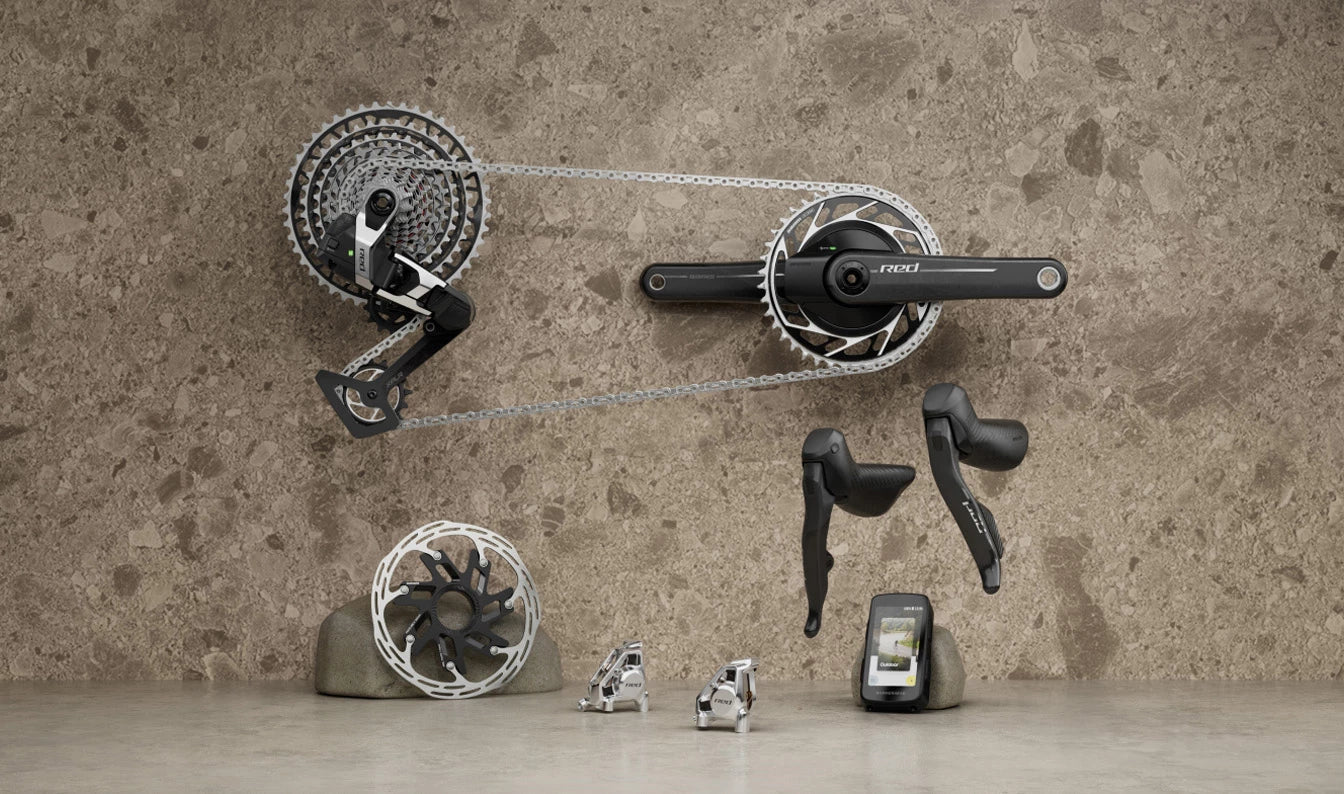
It is easy to get lost in the current SRAM lineup with names like AXS, XPLR, Eagle, and the varying gear counts. However, the hierarchy itself remains simple: Apex → Rival → Force → RED. The differences between groups are no longer just about weight and price, as SRAM is simultaneously developing road, gravel, and hybrid drivetrains that utilize MTB components.
The most important distinction today is this: classic road groups Rival, Force, and RED AXS remain 12-speed, while the newest gravel-specific Rival, Force, and RED XPLR AXS have moved to 13 speeds, a 10–46T cassette, and a Full Mount construction. Apex continues to use 12 speeds and is available both as AXS and in a mechanical version.
Also compare: Shimano 2026 groups – which one to choose?
SRAM Apex – the simplest entry into modern gravel
Apex opens up the current SRAM offering for drop-bar bikes. In the current generation, it is a 1x12 drivetrain, available with both classic mechanical DoubleTap shifting and in a wireless AXS version.
There are two primary directions to choose from. Apex XPLR uses cassettes with a 44T maximum cog and fits well for versatile gravel riding, asphalt, and dirt roads. Apex Eagle allows for pairing drop-bar shifters with the wider range known from MTB – up to 10–52T – which makes sense for bikepacking, mountain riding, and heavily loaded bikes.
Importantly, the mechanical Apex is no longer the old 1x11 group. The current mechanical generation also has 12 speeds and hydraulic disc brakes.

photo — SRAM
Apex makes the most sense where a reasonable price, wide range, and simplicity are important. It does not offer the weight or finish of Force or RED, but in terms of functionality, it offers much more today than the old budget-friendly SRAM.
SRAM Rival AXS – the sensible middle ground
Rival AXS remains one of the most versatile SRAM drivetrains. In the road version, it is a wireless 12-speed system that can run in a 1x or 2x configuration. It supports cassettes from 10–28T to 10–36T, making it well-suited for both classic road bikes and endurance bikes.
In gravel, the situation is different today. The latest Rival XPLR AXS is now a 1x13 drivetrain with a 10–46T cassette and a Full Mount rear derailleur. It does not use a classic derailleur hanger – it mounts directly to the frame using the UDH interface.
This is very important when upgrading an existing bike. The older 12-speed Rival XPLR could be installed on many traditional frames, whereas the current 13-speed Full Mount generation requires a frame designed accordingly.

photo — SRAM
For most people looking for wireless SRAM, Rival is the place to start. It provides the basic capabilities of the AXS system, modern levers, and hydraulic brakes, and the price difference compared to Force is still clear.
SRAM Force AXS – the high end without the RED price
Force AXS sits between Rival and RED. The road-going Force still runs a 12-speed system and can be configured as 2x. This is a group for fast road riding, endurance, and ambitious training, where lower weight and better materials begin to play a larger role.
The current Force XPLR AXS, however, uses the same basic gravel architecture as Rival and RED XPLR: 1x13, 10–46T cassette, and Full Mount.
In practice, Force is a very interesting point in the SRAM hierarchy. It provides many of the solutions found in RED, but without the extreme fight for every gram. For a performance bike that is meant to be ridden a lot, rather than just look good on a spec sheet, Force is often the most rational high-end group.

photo — SRAM
SRAM RED AXS – the top-tier road group
RED AXS remains SRAM’s flagship road group. The current rear derailleur is 12-speed, operates wirelessly, and supports 1x and 2x configurations with cassettes up to 10–36T.
The biggest difference compared to Force is not, therefore, the number of gears. RED uses more expensive materials, is lighter, has more refined components, and is designed primarily for racing and bikes where weight is a real concern.
In daily use, Force can perform very similarly. RED starts to make the most sense when the bike is intended to be built without major weight or financial compromises.
RED XPLR AXS – top-tier 1x13 gravel
RED XPLR AXS is a separate gravel branch of the top-tier group. It is a 1x13 system using a 10–46T cassette and a Full Mount rear derailleur mounted to a frame with a UDH interface.
SRAM has applied a strong chain-stabilizing clutch, an impact-resistant construction, and the Magic Wheel lower derailleur pulley, designed so the drivetrain can continue to operate even if debris gets into the pulley elements.
RED XPLR makes the most sense primarily in a light, sporty gravel bike. For a touring bike, the wide-range Apex Eagle cassette might be more practical, even though it sits several levels lower in the hierarchy.

photo — SRAM
More: Which gravel drivetrain in 2026? Shimano, SRAM, and Campagnolo
AXS, XPLR, Full Mount, and Eagle – what do they actually mean?
AXS is SRAM’s electronic ecosystem. Components communicate wirelessly, and the app allows you to, among other things, change button functions, check battery status, and update firmware.
XPLR denotes a family of components developed primarily for gravel and all-road bikes. It does not, however, automatically mean Full Mount or 13 speeds. Apex XPLR is still a 12-speed system, and there are also many older 12-speed Rival and Force XPLR drivetrains on the market.
Full Mount applies to the current gravel 1x13 Rival, Force, and RED XPLR AXS groups. The rear derailleur is mounted without a classic hanger and requires a frame with a UDH interface.
Eagle comes from MTB. However, SRAM allows some Eagle components to be combined with drop-bar road shifters. This makes particular sense in touring gravel setups, where 10–50T or 10–52T cassettes are useful.
SRAM 2026 hierarchy – a quick comparison
| Group | Current Drivetrain | Application | For whom? |
|---|---|---|---|
| Apex | 1x12 mechanical / AXS | gravel, bikepacking | reasonable price and wide range |
| Rival AXS | 12-speed, 1x / 2x | road, endurance | the most versatile AXS |
| Rival XPLR AXS | 1x13, 10–46T, Full Mount | gravel | modern gravel without overpaying |
| Force AXS | 12-speed, 1x / 2x | road, sport | high end and reasonable weight |
| Force XPLR AXS | 1x13, 10–46T, Full Mount | sporty gravel | ambitious riding and racing |
| RED AXS | 12-speed, 1x / 2x | road, racing | top-tier road performance |
| RED XPLR AXS | 1x13, 10–46T, Full Mount | racing gravel | low weight and top components |
Which SRAM group should you choose?
- For your first gravel bike: Apex XPLR. Mechanical if you value simplicity, or AXS if you want to jump straight into electronics.
- For bikepacking and mountain riding: Apex Eagle with a wide cassette can be more practical than significantly more expensive groups.
- For road and endurance: Rival AXS provides a very good balance of price, ergonomics, and capabilities.
- For modern gravel: Rival XPLR AXS 1x13 is a sensible entry point into the new Full Mount generation.
- For fast riding and racing: Force AXS on the road or Force XPLR AXS for gravel.
- Without major budget compromises: RED AXS or RED XPLR AXS.
Alternative: Campagnolo Ekar GT – mechanical 1x13 for gravel
Is a more expensive SRAM group always better?
Not on every bike. Switching from Apex to Rival provides a big change if you are looking for wireless AXS and better ergonomics. Force reduces weight and raises the build quality. RED takes these features even further, but at an increasingly higher cost.
In gravel, range is also a factor. For a race on fast dirt roads, XPLR 10–46T will be a very good solution. On a multi-day trip with luggage, Apex combined with an Eagle 10–52T cassette might perform better than top-tier RED XPLR.
Therefore, it is worth determining your riding style first, and only then the group level. The position in the hierarchy alone does not tell you which drivetrain will be best for a specific bike.

photo — SRAM
Summary
The SRAM hierarchy is still simple: Apex → Rival → Force → RED. In 2026, however, you also need to look at the specific branch of the drivetrain.
Apex remains a 12-speed 1x group and offers the widest choice between mechanical, AXS, XPLR, and the wide-range Eagle. Rival, Force, and RED are available as 12-speed road AXS groups, while their latest XPLR counterparts form a separate family of 1x13 gravel drivetrains with a 10–46T cassette and Full Mount.
The most expensive group will not always be the best choice. For most bikes, it is primarily worth choosing the right gear range, 1x or 2x configuration, and the level of electronics you will actually use.


Leave a comment